
Blue Bossa Chords for Jazz Guitar: The Chart and 7 Voicings
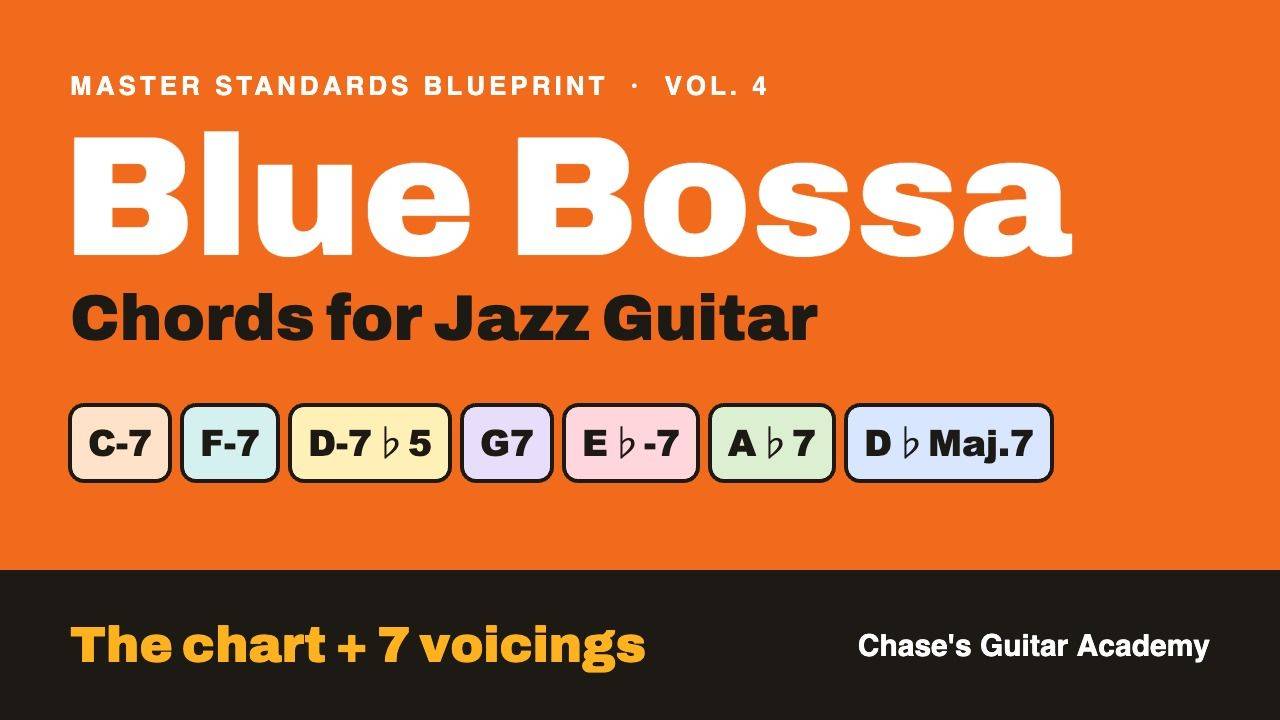
Nov 10, 2026Short answer: Blue Bossa, by Kenny Dorham, is a 16-bar tune in C minor. It uses seven chords: C-7, F-7, D-7♭5, G7, E♭-7, A♭7 and D♭Maj.7. Bars 1–8 and 13–16 are in C minor, and bars 9–12 move to D♭ major. On many charts the same chords are written Cm7, Fm7, Dm7♭5, G7, E♭m7, A♭7 and D♭maj7.
Not sure what to practice next? Take the free 10-minute Guitarist Profile quiz →
Blue Bossa chord chart
% means the same chord as the bar before. The colors match the voicings below.
On a lead sheet, bar 16 is often a D-7♭5 → G7 turnaround that takes you back to the top. It's the same two chords you already play in bars 5–6 and 13–14. On my own chart I write the G7 as G7alt and the A♭7 as A♭13.
7 Blue Bossa voicings I actually use
These come from the 5-position study we do on this tune in the Master Standards Blueprint. Everything sits in the first six frets. The orange dot is the root. Two of them have no root at all, which is normal in jazz comping: the bass player has it.
The same voicings as fret numbers, low E string to high E string (x = don't play that string):
| Chart says | Play | Frets (low E → high E) |
|---|---|---|
| C-7 | C-9 | x 3 1 3 3 x |
| F-7 | F-9 | x x 1 1 1 3 |
| D-7♭5 | D-7♭5 | x 5 6 5 6 x |
| G7 | G7alt | x x 3 4 4 6 |
| E♭-7 | E♭-9 | x 6 4 6 6 x |
| A♭7 | A♭13 | 4 x 4 5 6 x |
| D♭Maj.7 | D♭Maj.9 | x 4 3 5 4 x |
The chord shape is also what your lines hang on. If you can't see the C minor voicing in the position you're playing in, the lines you learn there are floating. They aren't tied to the harmony.
How Blue Bossa is built
The whole tune is three short progressions:
That's why it's such a useful tune to learn. In 16 bars you practice the minor ii-V-i twice and the major ii-V-I once, and the tune changes key and comes back.
Where Blue Bossa fits
Most tune lists come down to "learn these because I say so." I order tunes by one rule: each new tune adds no more than three new chords, and reuses the chords you already know. You learn one new idea and use it right away on the tune in front of you. It feels like walking up a staircase instead of swimming between unconnected islands.
Here's the start of that staircase, and where Blue Bossa sits on it:
By the time you reach Blue Bossa, you already know five of its seven chords:
So Blue Bossa costs you two new chords and one new idea: the minor ii-V-i. The major ii-V-I in bars 9–12 is the same move you practiced all through Volume 3, in a new key.
That's why it comes here and not first. Learn it too early and you're fighting five or six new chords at once. Learn it here and nearly everything is review, so your attention goes to the one thing that's new.
Then the next two tunes in the volume, Black Orpheus and Corcovado, give you the minor ii-V-i again in other keys. The full system is in the best order to learn jazz standards.
The four Blue Bossa classes
A good test before you move on to the next tune: play the minor ii-V-i, D-7♭5 to G7 to C-7, and play one real line over it without stopping.
Blue Bossa scales (and why I don't teach soloing this way)
People search for the scales to use on Blue Bossa, so here they are. Read this first, though.
If I were going to think about Blue Bossa in scales, this is how I'd do it:
| Chord | Scale |
|---|---|
| C-7 | C Dorian |
| F-7 | F Dorian |
| D-7♭5 | Keep thinking F Dorian (or F melodic minor) |
| G7alt | A♭ melodic minor |
| E♭-7 and A♭7 | E♭ Dorian for both |
| D♭Maj.7 | D♭ major |
A lot of lessons tell you to play C harmonic minor over the D-7♭5 and G7. I never think about it that way. To me harmonic minor isn't really a scale there. It's one way of playing through the minor ii-V.
What I think about instead
I see four approaches to improvising, and most players move through them in this order:
If you stay inside the scale, you never play a wrong note. You also never get the tension and the chromatic notes that jazz lines are made of. Good use of chromatic notes is the clearest sign a player has left the scale approach behind.
When I solo over C minor, I'm never thinking "these are the notes in C minor". I'm either playing vocabulary I've learned, or I'm hearing a note I want to land on and finding a way to get to it. Those two feed each other. That's what we work on in the Blue Bossa classes, and it's what soloing with target notes is about.
Frequently asked questions
What are the chords to Blue Bossa?
C-7, F-7, D-7♭5, G7, E♭-7, A♭7 and D♭Maj.7. Bars 1–4 are C-7 and F-7 (two bars each), bars 5–8 are D-7♭5, G7 and C-7, bars 9–12 are E♭-7, A♭7 and D♭Maj.7, and bars 13–16 repeat bars 5–8.
What key is Blue Bossa in?
C minor. Bars 9–12 move to D♭ major for four bars, then the tune returns to C minor.
How many bars is Blue Bossa?
16 bars. You play the form once for the melody and then keep repeating it for solos.
Who wrote Blue Bossa?
Kenny Dorham.
What scale do you use to solo over Blue Bossa?
If you want scales: C Dorian on C-7, F Dorian on F-7 and D-7♭5, A♭ melodic minor on G7alt, E♭ Dorian on E♭-7 and A♭7, and D♭ major on D♭Maj.7. But a scale for every chord is not how professional players think when they improvise, and it's not what Chase teaches. He teaches target notes and vocabulary.
Should I use C harmonic minor on Blue Bossa?
Many lessons suggest it for the D-7♭5 and G7 bars. Chase doesn't think about it that way: he treats harmonic minor as one way of playing through the minor ii-V, not as a scale to run.
When should I learn Blue Bossa?
After modal tunes, blues tunes and a few major ii-V-I tunes like Take the A Train and Tune Up. By then you know five of its seven chords, so it only adds two new chords (D-7♭5 and D♭Maj.7) and one new idea, the minor ii-V-i.
Is Blue Bossa a good tune to know for jam sessions?
Yes. It's one of the Latin standards that gets called at jam sessions, along with Black Orpheus and Corcovado.
Keep learning
- The best order to learn jazz standards: where Blue Bossa fits, and which tunes to learn before and after it
- How to play a ii-V-I on jazz guitar without licks: a way into the ii-V-I in bars 9–12
- How to solo over jazz chords with target notes: what to aim for when the chord changes
- Cantaloupe Island chords for jazz guitar: the chart, 3 voicings and Herbie Hancock's two-note comping
Go deeper
Not sure what to practice next? Take the free Guitarist Profile quiz: 10 minutes, and you get your practice mindset, your strongest and weakest skills, and a 28-day plan. Find out what kind of jazz guitarist you are →
If you want me to guide you through it, that's what we do inside Chase's Guitar Academy. The Master Standards Blueprint takes you through jazz standards step by step, with the fundamentals and lines that go with each tune, and every week we work through a tune together in the live class. You can try it free for seven days.
"Chase's idea that you should start with small things and build up from essential vocabulary and essential jazz patterns - it's really been an effective way to gain mastery in guitar play." Benoît F., CGA member
50+ five-star reviews from CGA members, most of them on video: read what members say.
Chase Maddox is a jazz guitarist and educator in Miami and the founder of Chase's Guitar Academy. George Benson has called him "an amazing instructor." More free lessons are on his YouTube channel.
