
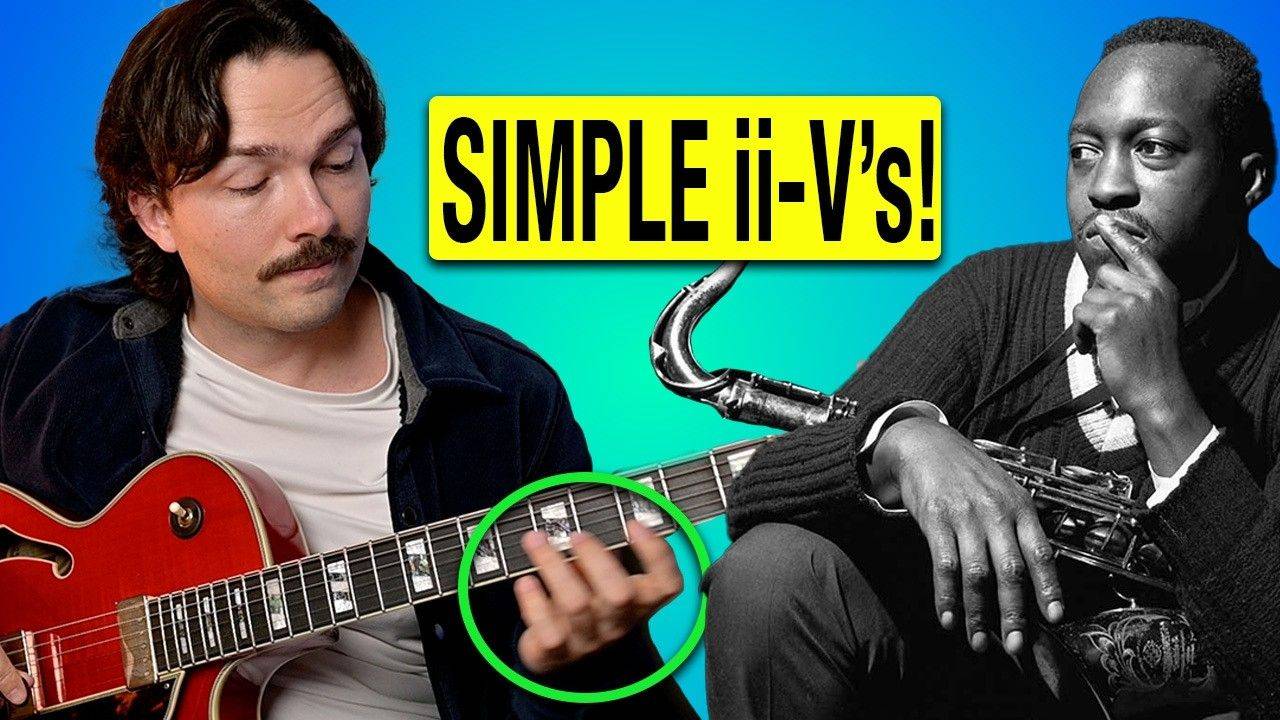
How to Play Over ii-V-I Progressions on Jazz Guitar (Without Memorizing Licks)
Oct 16, 2026Short answer: Don't start with ii-V-I licks or a different scale for every chord. Start at the end. Learn the resolution notes on the I chord first, then use one small triad shape over the V chord that slides down a half step into those resolution notes, then one triad over the ii chord. That gives you melodic lines you can actually hear, and it's how players like Chet Baker and Hank Mobley build their lines over a ii-V-I.
This lesson is in the key of C (D-7 – G7 – CMaj.7), all in one position around the 3rd fret. You don't need much theory to use it. If note names don't help you, just follow the shapes.
Why the usual approach to ii-V-I doesn't work
The ii-V-I is in nearly every jazz standard, so everyone tells you to learn ii-V-I licks. The problem is that a memorized lick is just a string of notes. You aren't hearing where it resolves, so it never comes out naturally when you improvise.
The other common approach is to think of a scale or arpeggio for every chord: D Dorian, then G altered or A♭ melodic minor, then an E-7 arpeggio over C major. That's a lot to think about when each chord lasts four beats, or two. Most people freeze. If that's you, it isn't a talent problem. It's the approach. ▶ 3:03
Step 1: Start at the resolution (the I chord)
Chess players study the endgame first. Do the same thing here: before you play anything over D-7 or G7, get comfortable landing on CMaj.7. ▶ 4:10
Any note of the CMaj.7 chord (C, E, G, B) is a good place to resolve. Each one gives the end of your phrase a slightly different feeling.
How to practice it: Put on a ii-V-I backing track and play nothing over the ii and the V. Let them go by, then play one note of CMaj.7 when the I chord arrives. ▶ 6:23
This trains two things at once:
- You get comfortable with the space of the ii-V and stop feeling anxious while it's going by.
- You learn what each resolution note sounds like over the I chord.
Knowing where you're going makes you more confident. Worst case, you just land on one of those notes and you're fine.
Step 2: One triad over the V chord (G7)
Now work backwards one chord. Over G7, use an F minor triad (F, A♭, C). ▶ 7:41
Why that triad? Move any of its notes down one fret (a half step) and you land on a resolution note for CMaj.7:
| Note on G7 | Slides down to | On CMaj.7 that's the |
|---|---|---|
| F | E | 3rd |
| A♭ | G | 5th |
| C | B | 7th |
So you can play around with the F minor triad over G7, and wherever you happen to be when C major arrives, slide that note down a half step. That's voice leading, and it's the core of a good ii-V-I line. ▶ 8:26
You don't have to resolve exactly on beat one. In the video I anticipate the CMaj.7 and resolve early, and you can also resolve late. Make the move where it feels musical. ▶ 10:37
Step 3: One triad over the ii chord (D-7)
Over D-7, use an F major triad (F, A, C). It's almost the same shape as Step 2. Only one note changes: A becomes A♭ when the chord moves to G7. ▶ 12:05
So the whole ii-V-I comes down to this:
- D-7: play around with F, A, C.
- G7: lower the A to A♭ (F, A♭, C).
- CMaj.7: slide whatever note you're on down a half step.
Listen to the examples at ▶ 13:07. They're simple, but they're melodic, and they give you something to build on: add rhythm, approach notes and eighth-note lines over time.
How Chet Baker and Hank Mobley do it
Both examples are from "Tune Up":
- Chet Baker uses the same F major triad over D-7, a different three-note triad over G7, then resolves clearly to the 3rd of the I chord. ▶ 14:34
- Hank Mobley uses notes from a D minor triad over D-7 and a G major triad over G7, then resolves to the major 7th and moves to the 6th. Most of what makes it melodic is the rhythm. ▶ 15:20
Neither one is running a memorized lick. They're using small triad shapes and steering them into the resolution, which is what you practiced in Steps 1–3.
Frequently asked questions
What should I play over a ii-V-I on guitar?
Start with the notes of the I chord, so you always know where you're resolving. Then add an F minor triad over G7 and an F major triad over D-7 (in the key of C) and slide into the I chord by a half step.
Do I need to learn ii-V-I licks?
Licks help later, but learning them first is why so many players sound mechanical. Once you can hear the voice leading, you'll understand the licks you learn and be able to make your own.
Do I need music theory for this?
No. You can do the whole lesson from the shapes in the video. The theory just explains why the half-step slides work.
Should I use a different scale for each chord in a ii-V-I?
Not at first. Switching scales every two to four beats is what overwhelms most players. One small triad per chord, connected by half steps, gets you a lot further.
Go deeper
Not sure where you stand? Take the free Guitarist Profile quiz: 10 minutes, and you get your practice mindset, your strongest and weakest skills, and a 28-day plan. Find out what kind of jazz guitarist you are →
The ii-V-I Standards Entry course inside Chase's Guitar Academy builds this approach into the standards you're learning, with more triad paths over the V chord. It's open to all members.
"I'm actually starting to feel comfortable improvising on top of a whole range of changes and with different techniques." Bill Evelyn, CGA member
50+ five-star reviews from CGA members, most of them on video: read what members say.
Chase Maddox is a jazz guitarist and educator in Miami and the founder of Chase's Guitar Academy. George Benson has called him "an amazing instructor." More free lessons are on his YouTube channel.
