
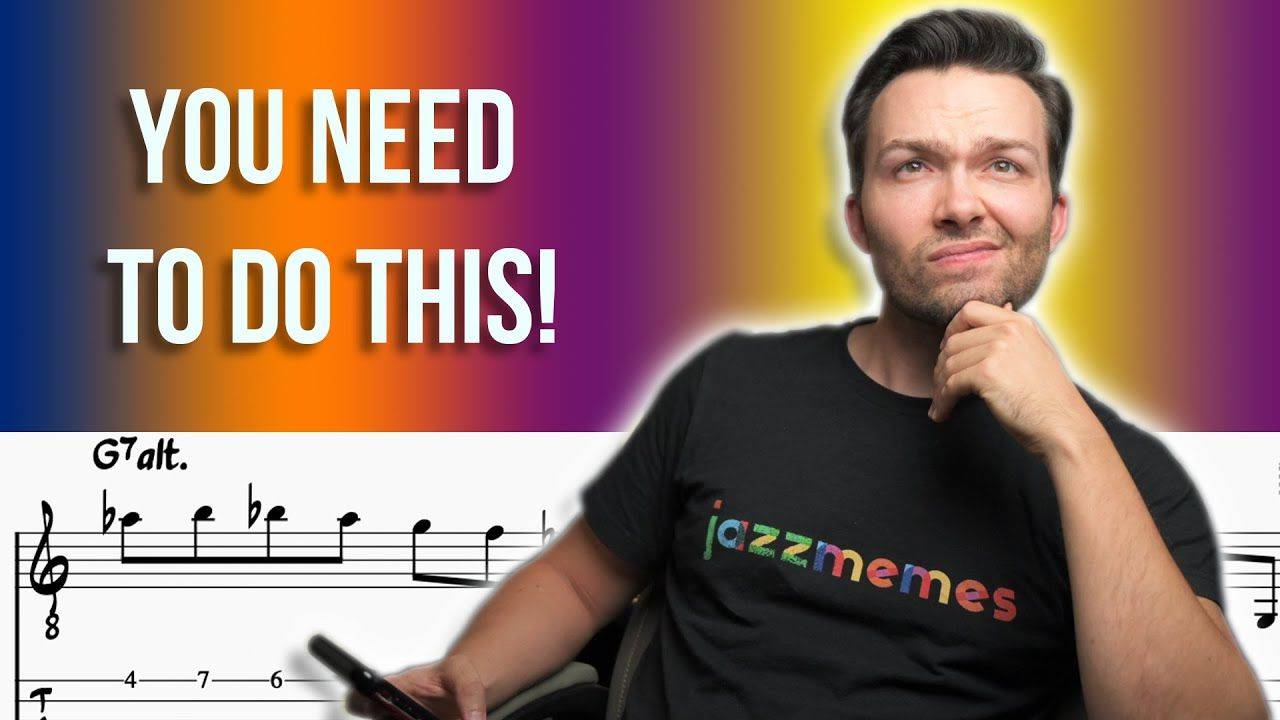
How to Play Constant 8th Note Lines Over the Rhythm Changes Bridge
Nov 09, 2026Short answer: The Rhythm Changes bridge is four dominant chords, two bars each: D7, G7, C7, F7. To play a constant 8th note line through it, hear the chords as alternating natural 13 and altered sounds (D13, G altered, C13, F7 altered), and on each chord change try to put a 3rd or 7th on the downbeat. To get the line there, use chromatic devices: shift a whole motif down a half step, add a four-note chromatic descending pattern, back up a note so the target falls on the beat, and use enclosures to land on the note you want.
This lesson builds on the line from my previous video, which was a long line over a single D7. Here the goal is to use the same ideas when a dominant chord only lasts a short time, and to keep the line moving in steady 8th notes. I do it in one position. ▶ 0:46 ▶ 1:41
If you want the two main ways to harmonize the A section of Rhythm Changes, see John Storie's lesson linked at the end. This page is all about the bridge.
The Rhythm Changes bridge: four dominant chords
The bridge of Rhythm Changes is D7 for two measures, G7 for two measures, C7 for two measures, then F7 for two measures. The chords move around the cycle of fifths, and it's a great place to practice playing over dominant chords. ▶ 1:48
The important thing is how you hear them. I think about them in terms of the secret jazz chord, which I've talked about in other videos. The bridge switches back and forth between a natural 13 sound and an altered sound. And while the roots move in fifths, the top note of the voicing moves down chromatically, a half step at a time. That's where a lot of the notes in the line come from. ▶ 2:13
| Bars | Chord | How I hear it | Top note of the voicing | What the line does |
|---|---|---|---|---|
| 1–2 | D7 | D13 | B | Opens with the start of last week's line (with the rest) ▶ 3:31 |
| 3–4 | G7 | G altered (from A♭ melodic minor) | B♭ | Lands on A♭, shifts the motif down a half step, then two notes per string ▶ 3:35 |
| 5–6 | C7 | C13♯11 (from G melodic minor) | A | Lands on B♭, the ii chord (G minor), C7 arpeggio, enclosures ▶ 5:10 |
| 7–8 | F7 | F7 altered | — | E♭, then A to A♭, F7 arpeggio, a diminished ending on F ▶ 8:43 |
D7 to G7: shift the whole motif down chromatically
We start with the beginning of last week's line, the one with the rest, and continue it by descending to A♭. That A♭ is our first beat on G altered. ▶ 3:31
Then I keep the same motif and repeat it down a half step. Instead of moving chromatically note by note, we take a whole phrase and shift it down chromatically. That's another way to use chromaticism. ▶ 3:50
From there, it's the two-notes-per-string pattern from last week: pick two notes from the scale on each string, then move to the next lower string. This time the scale is the melodic minor for G altered, which is A♭ melodic minor: F and E♭, then B natural and B♭. ▶ 4:12
Then comes the four-note descending chromatic idea to land on F, and then E♭ to B and two more notes. It's a bit of a stretch, so just jump your hand, and end on G. ▶ 4:39
Put 3rds and 7ths on the downbeat
As we hit C7, I land on B♭, the 7th. For every one of these chords, when the chord switches (D7 to G7, C7 to F7), I'm trying to hit a 3rd or a 7th on the downbeat. ▶ 5:02
That doesn't mean every downbeat has to be a chord tone. But whatever note lands on the downbeat, you want it to be intentional. ▶ 5:20
Force the note onto the beat you want
Here's a small device that does a lot of work. On C7, if I had just gone up from B♭ to D to F and right into E, the E wouldn't have been on the downbeat. I want it there, because it's the 3rd and it's stronger on the downbeat. So after F, I go back to D, and now E lands on the downbeat. ▶ 5:33
Jazz musicians improvise with little devices like this all the time. They use them to place the note they want on the beat they want, downbeat or upbeat. Once you have these patterns down, you start to do it without thinking. It's almost like a magician forcing a card. ▶ 6:08
When you analyze solos or write your own phrases, ask:
- Which notes fall on the downbeats and which on the upbeats?
- Is that intentional?
- What patterns does the player use to force a note to land where they want it?
Use the ii chord over the V
Also on C7, the line uses the ii chord, an idea from last week. Over C7 the ii is G minor, so the line plays G minor over the C7. Then it goes up a basic C7 arpeggio: C, E, G, B♭. ▶ 6:44
Enclosures: target a note from above and below
An enclosure is a chromatic device where the middle note is the target. You play a note above it, then a note below it (or below, then above), then the note in the middle. Hitting the upper and lower limits first tells the listener's ear that the note you land on is intentional. ▶ 7:13
| Enclosure | Target | Why that note |
|---|---|---|
| First one on C7 | A | The 13th of C7. Not a chord tone, but targeting extensions can sound really good ▶ 7:46 |
| Second one, leading into F7 | E♭ | The chord is about to switch to F7, and E♭ is the 7th of F7 ▶ 8:15 |
Put the enclosed note on a downbeat. The A isn't a chord tone, it's the 13th, and that's fine. Between the two enclosures there are two notes from G melodic minor, which is why the line goes to F♯: the C7 here is a C13♯11, and that sound comes from G melodic minor. ▶ 7:56
F7 altered and the ending
Over F7 the line has the E♭ (the ♭7), then A to A♭. This part comes from F altered, so you'll see a lot of ♯9 and ♭9. Then it goes into a basic F7 arpeggio, repeating the same kind of pattern as before, then F♯ to E♭. ▶ 8:43
It ends with a sort of diminished sound: C, A♭, G♭, F. That last F would be the 5th of B♭, because at that point in Rhythm Changes the tune goes back to the I chord. ▶ 9:16
Hear the whole line from the top: ▶ 9:32
How to practice this
- Learn the bridge as four sounds, not four chord names: D13, G altered, C13, F7 altered, with the top note sliding down chromatically.
- Check every chord change. Is a 3rd or a 7th on the downbeat? If not, use a device (back up a note, an enclosure, a chromatic pattern) to move it there.
- Reuse your long-line ideas in short spaces. The motif shift, the two-notes-per-string melodic minor pattern and the four-note chromatic descent all work in two bars.
- Take it to other positions. I do this line in one position here; work out the same ideas across the neck.
Frequently asked questions
What are the chords of the Rhythm Changes bridge?
In B♭, the bridge is D7 for two bars, G7 for two bars, C7 for two bars and F7 for two bars, a chain of dominant chords moving in fifths. It then goes back to the I chord, B♭.
What scales do you use over the Rhythm Changes bridge?
In this line, G altered comes from A♭ melodic minor, the C7 is heard as C13♯11 from G melodic minor, and the F7 is played as F altered. The D7 and C7 are natural 13 sounds; the G7 and F7 are altered.
Which notes should land on the downbeat when the chord changes?
Aim for a 3rd or a 7th of the new chord on the downbeat. Not every downbeat has to be a chord tone, but whatever lands there should be intentional.
What is an enclosure in jazz?
A chromatic device that targets a note by playing a note above it and a note below it (in either order) before landing on it. Put the target on a downbeat; it can be a chord tone or an extension like the 13th.
How do I keep a constant 8th note line going over short chords?
Use devices that let you move the line in time: shift a whole motif down a half step, run a four-note chromatic descent, or back up a note so the 3rd or 7th lands on the beat you want.
Keep learning
- How to play over Rhythm Changes: 2 paths for the A section (John Storie): the other half of the tune, outlined with arpeggios and change running
- The secret to bebop jazz guitar: chromatic approach patterns: more chromatic ways to target notes, from Pasquale Grasso and Charlie Parker
- The first ii-V-I line to learn on jazz guitar: enclosures and chord tones on strong beats in a single ii-V-I line
Go deeper
Not sure what to work on next? Take the free Guitarist Profile quiz: 10 minutes, and you get your practice mindset, your strongest and weakest skills, and a 28-day plan. Find out what kind of jazz guitarist you are →
If you want me to guide you, that's what we do inside Chase's Guitar Academy. The curriculum tells you what to practice each day, and every week we work through a tune together in the live class. You can try it free for seven days.
"It has been over a year now since I joined CGA, and I have learned so much. One of my best moments is the 'Finish That Line' class where Chase gives you the opportunity to continue a line from your own creativity." Pierre D., CGA member
50+ five-star reviews from CGA members, most of them on video: read what members say.
Chase Maddox is a jazz guitarist and educator in Miami and the founder of Chase's Guitar Academy. George Benson has called him "an amazing instructor." More free lessons are on his YouTube channel.
