
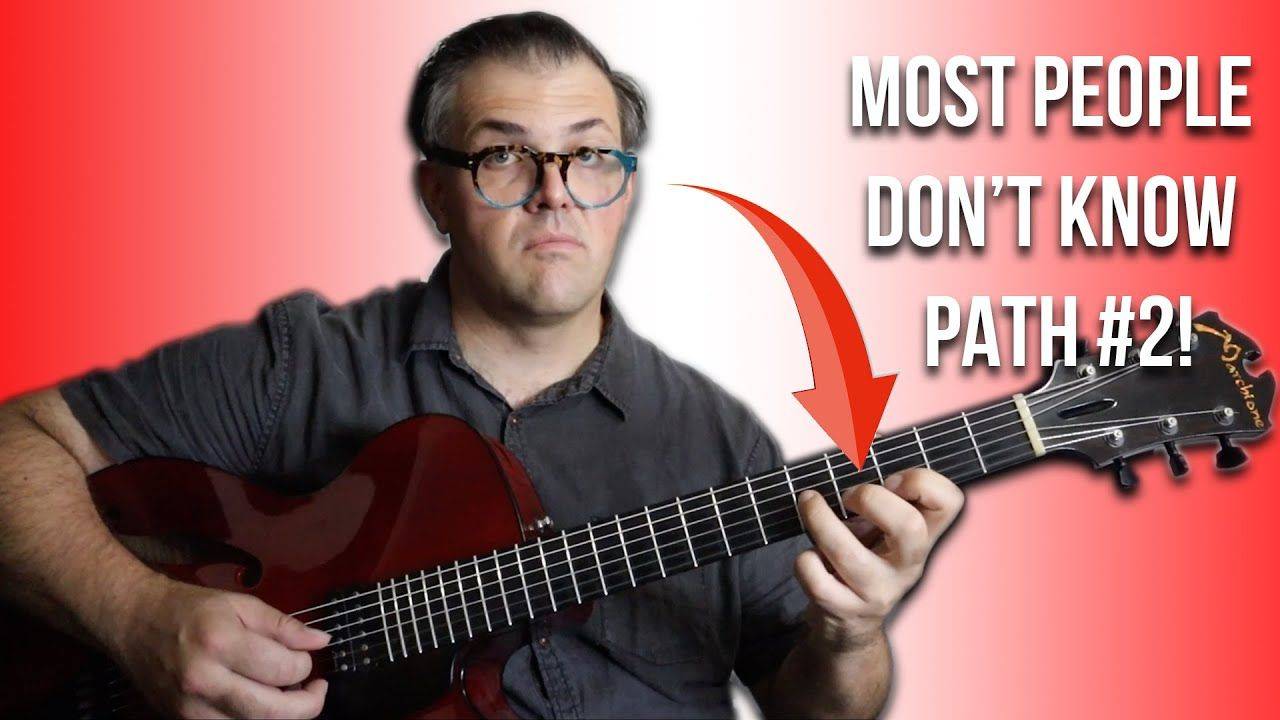
How to Play Over Rhythm Changes on Guitar: 2 Paths for the A Section (John Storie)
Nov 08, 2026Short answer: Guitarist John Storie practices the first eight bars of Rhythm Changes over two versions of the chords. Option A is I-VI-II-V, III-VI-II-V (the VI can be minor or dominant). Option B uses passing diminished chords: I, ♭II diminished, II, ♭III diminished, III, then VI-II-V. In B♭ that second version starts B♭, B diminished, C minor, C♯ diminished, D minor. For each one, first arpeggiate every chord, then practice change running: outline the chords with arpeggios, but go up through one and down through the next, the way Charlie Christian did.
This lesson started with a question from the comments. It isn't a chord melody question, John says, but an outlining question: how do you make the chords of Rhythm Changes audible in a single-note line? His answer covers the A section of the classic tune, I Got Rhythm by George Gershwin, and the two main ways it's harmonized. ▶ 0:00
| Option A: I-VI-II-V | Option B: passing diminished | |
|---|---|---|
| The first four chords | I, VI, II, V | I, ♭II diminished, II, ♭III diminished |
| What follows | III, VI, II, V | III, VI, II, V |
| In B♭, as John names it | (said in numbers only) | B♭, B diminished, C minor, C♯ diminished, D minor |
| The VI chord | Minor or dominant | n/a |
| Where it's demonstrated | Arpeggiated ▶ 0:47, played ▶ 2:11, change running ▶ 2:55 | Played ▶ 2:19, change running ▶ 3:08 |
Path 1: I-VI-II-V, III-VI-II-V
The first version of the A section is the one most players learn first: I to VI, II, V, then III, VI, II, V. ▶ 0:20
When John arpeggiates it, he plays the VI as a dominant chord and the II as a minor chord: 1, 6 dominant, 2 minor, 5 dominant, 1. ▶ 0:57 Later, when he gives you the practice assignment, he says the VI can be either minor or dominant, so try both. ▶ 1:45
Path 2: the passing diminished version
The second version replaces the VI chord with a chromatic climb. In John's words, it goes 1, ♭2 diminished, 2, ♭3 diminished, 3, and from there it's VI-II-V again. ▶ 0:25
That's how he thinks about it in numbers. Spelled out in B♭, the bass walks up by half steps: B♭, B diminished, C minor, C♯ diminished, D minor, then again VI-II-V-I. ▶ 0:33
Step 1: arpeggiate every chord
"Our first step when really outlining any chord changes," John says, "is to break down the chords we're playing and to arpeggiate each one of them." ▶ 1:00 Before you try to solo, play each chord of the progression as an arpeggio so you can hear every change go by.
He then plays through both options, first at tempo and then a little slower: Option A at ▶ 2:11, Option B at ▶ 2:19, and both again slower from ▶ 2:25.
Step 2: change running
The next step is change running. John credits the term to Jerry Coker, who wrote about it in his book on jazz patterns. ▶ 1:10
Change running means you still outline the chord changes with arpeggios, but you create contours: you go up one chord and down another. ▶ 1:20 John plays two examples ▶ 1:29, and says this is a way to create the kind of flow we have in bebop. ▶ 1:38
He then change-runs through both versions of the A section:
- Option A at ▶ 2:55. Along the way he uses a ♭9 on the G7, which in B♭ is the VI chord played as a dominant. ▶ 3:05
- Option B, with the passing diminished chords, at ▶ 3:08. One of the lines he plays there is, as he puts it, "a very famous riff" that we've heard in jazz before. ▶ 3:28
Step 3: solo, and test your ears
Next John speeds up and solos over the first eight bars of Rhythm Changes. ▶ 3:39 Before he plays, he gives you an ear-training job: listen back and try to hear which version he's outlining, the one that starts with the passing diminished chords or the one that starts with I to VI to II-V. ▶ 3:45
His solo starts at ▶ 4:02. Once you've arpeggiated and change-run both progressions yourself, try the same test on your own playing.
Listen to Charlie Christian
When John plays lines like these, he instantly thinks of Charlie Christian, whom he calls the founding father of the guitar in jazz, next to players like George Barnes and Les Paul, and one of the first electric guitarists. ▶ 4:54
His listening tip: Christian's solos with Benny Goodman's band, on a tune like Air Mail Special. Christian is "straight up outlining these chords, but alternating going up and down through each one." ▶ 5:05 In other words, change running.
How to practice the A section of Rhythm Changes
John's routine, in his own order: ▶ 5:15
| Step | What to do | Why |
|---|---|---|
| 1 | Set aside both chord progressions (Option A and Option B) | John calls them two of the main types of Rhythm Changes |
| 2 | Arpeggiate each chord of each progression | Breaking down the chords is the first step in outlining any changes |
| 3 | Change run: arpeggiate up through one chord and down through the next | Contours turn arpeggios into lines with bebop flow |
| 4 | Solo over the eight bars and listen back | Check whether you can hear which version you, or John, are outlining |
Frequently asked questions
What are the two main versions of the Rhythm Changes A section?
John Storie teaches two: I-VI-II-V, III-VI-II-V (with the VI minor or dominant), and a version with passing diminished chords: I, ♭II diminished, II, ♭III diminished, III, then VI-II-V. In B♭ the second one starts B♭, B diminished, C minor, C♯ diminished, D minor.
How do you start practicing Rhythm Changes on guitar?
John Storie's first step is to arpeggiate every chord of the progression. He suggests doing it over both versions of the A section, then moving on to change running.
What is change running?
It's a term John Storie credits to Jerry Coker. You outline the chord changes with arpeggios but create contours, going up through one chord and down through the next. John says it creates the kind of flow we have in bebop.
Which guitarist should I listen to for outlining chord changes?
John Storie points to Charlie Christian, especially his solos with Benny Goodman's band on a tune like Air Mail Special, where Christian outlines the chords while alternating up and down through each one.
Is Rhythm Changes based on I Got Rhythm?
Yes. John Storie introduces the two versions as harmonizations of the classic song I Got Rhythm by George Gershwin.
Keep learning
- Charlie Christian's Rose Room solo: go deeper on the guitarist John names as the model for change running
- Jazz guitar arpeggio workout: build the arpeggio fluency step 1 depends on
- Joe Diorio solo guitar techniques (John Storie): another lesson from John Storie
Go deeper
What kind of jazz guitarist are you? Take the free Guitarist Profile quiz: 10 minutes, and you get your practice mindset, your strongest and weakest skills, and a 28-day plan. Find out what kind of jazz guitarist you are →
If you want me to guide you, that's what we do inside Chase's Guitar Academy. The curriculum tells you what to practice each day, so you can spend your energy playing instead of second-guessing, and every week we work through a tune together in the live class. You can try it free for seven days.
"It's only been a few weeks, but I can already feel that my soloing is more intricate." Maxime Counet, CGA member
50+ five-star reviews from CGA members, most of them on video: read what members say.
Chase Maddox is a jazz guitarist and educator in Miami and the founder of Chase's Guitar Academy. George Benson has called him "an amazing instructor." More free lessons are on his YouTube channel.
