
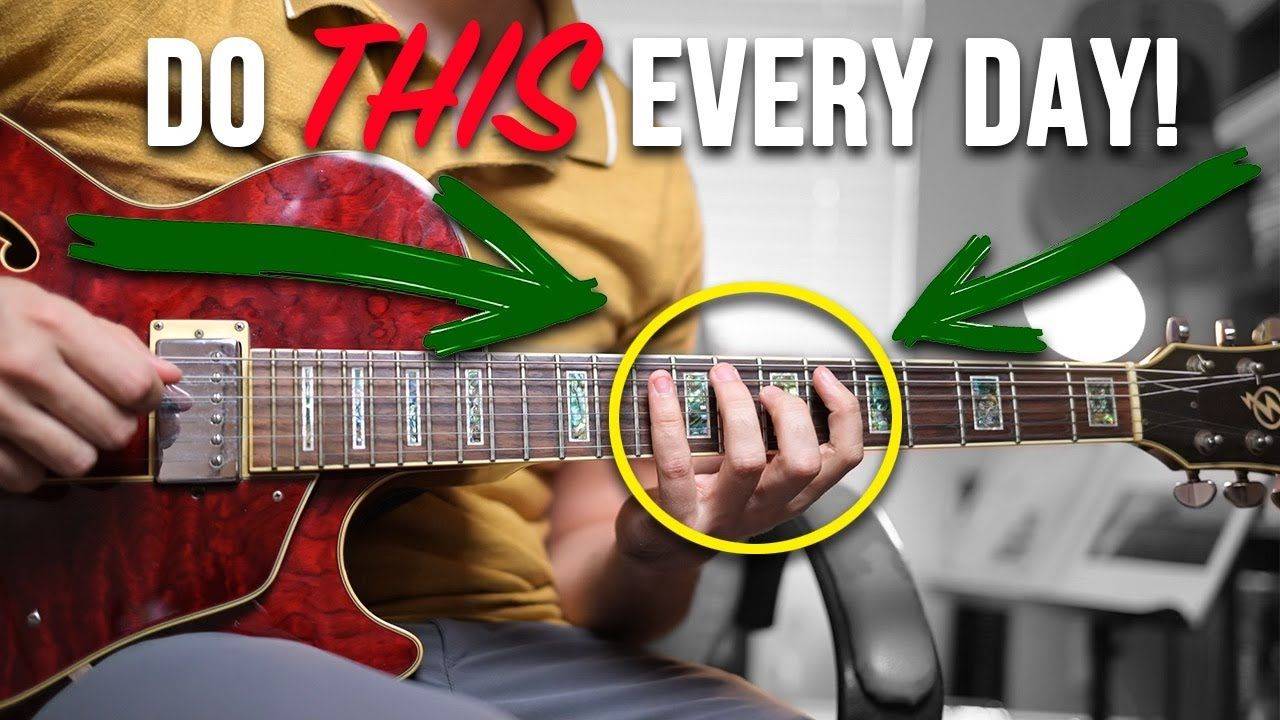
How to Practice ii-V-I Lines in All 12 Keys and 5 Positions: A Full ii-V-I Workout for Jazz Guitar
Nov 09, 2026Short answer: Learn one ii-V-I line in each of the five positions (in C: D-7, G7, CMaj.7). Every line comes down the minor 7 chord, then plays a diminished arpeggio from the ♭9 of the dominant (A♭ over G7) and resolves to the 3rd of the I chord (E). Then take one shape and move it through every key with a tune made of ii-V-Is like Tune Up, and play all five positions in one key with a tune like Autumn Leaves. Once the lines are in your hands, change the rhythm (hold a note, then catch up with a triplet) and the resolution note (land on the 5th instead of the 3rd).
The ii-V-I is one of the most important progressions in jazz and one of the first you should master if you want to be a fluent improviser. This workout takes you through all five positions and all 12 keys in three steps: the five lines, then applying them over standards, then some more advanced ways to make them your own. ▶ 0:18
| Step | What you do | Where it's shown |
|---|---|---|
| 1. Learn the five lines | One ii-V-I line per position, each tied to a D minor chord shape | ▶ 0:56 |
| 2. One shape, every key | Move a single shape through the key changes of Tune Up | ▶ 3:56 |
| 3. Every position, one key | Play all the shapes in B♭ over Autumn Leaves | ▶ 6:20 |
| 4. Make them your own | Change the rhythm and the resolution note | ▶ 8:30 |
| 5. Add diminished | Swap in diminished patterns over the V chord | ▶ Diminished 1:21 |
The five ii-V-I lines
Connect each line to the chord shape it's built on. All five are in C (D-7, G7, CMaj.7), and they share two things you're working on: coming down through the ii chord (the minor chord), and having the arpeggio for the dominant chord. ▶ 0:56 ▶ 1:34
Over every dominant chord, the lines use the same kind of diminished arpeggio. In the first line it's played as a pivot arpeggio, which just means you jump by a 6th, here from A♭ up to F, and then resolve to E, the 3rd of C major. ▶ 1:20 ▶ 1:34
Here's shape 1 note by note, from the on-screen notation:
| Chord | Notes | What's happening |
|---|---|---|
| D-7 | E F E C A F E C | Coming down through D minor (shown as D-9) |
| G7 | B D F A, A♭ F D D♯ | Up the chord to A, down a half step to A♭, jump up a 6th to F (the pivot arpeggio), then D and D♯ |
| CMaj.7 | E | Land on the 3rd |
The other four positions use the same ingredients: ▶ 2:20
| Shape | What to notice | Where it's shown |
|---|---|---|
| 1 | The pivot arpeggio: A♭ up to F, then resolve on E | ▶ 1:09 |
| 2 | Next D minor position up, with that A♭ again, landing on the 3rd | ▶ 2:20 |
| 3 | The same diminished notes, split up: instead of A♭ B D F in a row, F, jump down to A♭, then walk back up through B and D to E | ▶ 2:47 |
| 4 | Shape 1's line an octave higher on a different D minor shape: A♭ up to F, resolving on E | ▶ 3:18 |
| 5 | Up the chord, then A♭ B D F straight up the diminished arpeggio, resolving on E | ▶ 3:31 |
Every line resolves to the 3rd for now. Later we'll change the resolution and the rhythm. ▶ 3:42
Step 2: one shape through every key (Tune Up)
Tune Up is a great tune for ii-V-I exercises because it's really just several ii-V-Is in different keys. Take one shape, say shape 1, and keep moving it as the key changes. The point is to practice a single shape in different keys. ▶ 3:56 ▶ 4:14
Over E-7, A7, DMaj.7, shape 1 becomes F♯ G F♯ D B G F♯ D, then C♯ E G B, A♯ G E F, landing on F♯, the 3rd of D. ▶ 4:41
One detail to catch: in the form there's a spot where you get what's almost a full ii-V to D (E-7, A7), but it goes E-7, F7, B♭Maj.7 instead. Start the ii chord the same way, then when you get to F7, switch to that chord's line, starting on A: A, C, E♭, G, then pivot to land on D, the 3rd of B♭. So it's a combination of two different ii-V-Is. ▶ 5:30 ▶ 6:00
Step 3: every position in one key (Autumn Leaves)
Now apply the lines in multiple positions in one key. Autumn Leaves has a ii-V to B♭ (C-7, F7, B♭Maj.7, going to E♭Maj.7) and a minor ii-V to G minor (A-7♭5, D7, G-). Without getting into the theory, you can use the same ii-V line for C-7, F7, B♭ as for that minor ii-V. So everything here comes from ii-V-Is in the key of B♭, played in all the positions as the tune goes by. ▶ 6:20 ▶ 6:35
| Autumn Leaves chords | What to play |
|---|---|
| C-7, F7, B♭Maj.7 | A ii-V-I line in B♭ |
| E♭Maj.7 | Rest and get ready for the next line |
| A-7♭5, D7, G- | The same B♭ ii-V line |
When there isn't a ii-V, like that E♭ major, leave it as a rest and get ready for the next ii-V-I line you want to practice. ▶ 8:06
Step 4: make the lines your own
These two techniques work in any position. ▶ 8:30
- Change the rhythm. Right now the lines are all eighth notes. Hold one note, then add a triplet, so the feel isn't always straight eighth-note lines. It sounds more natural, and it's what happens in real playing when you get stuck on a note and need to catch up. I like it over the arpeggio part, or wherever a sweep with my right hand makes sense, but it doesn't have to be a sweep. ▶ 8:39 ▶ 9:15 ▶ 9:47
- Change the resolution note. Landing on the 3rd really captures the sound of the major chord, but you don't always want to end there. With shape 2, end on the 5th instead, and use the remaining notes to enclose the 5th. Then when you get to that point, decide by ear: go to the 3rd or the 5th? There are lots of options, including one that combines both. ▶ 10:18 ▶ 10:50 ▶ 11:02
Combine the rhythm changes and the different resolution points and you get real freedom inside these exercises. ▶ 11:36
One more thing: every line here starts with a descending arpeggio on the minor 7 chord. You won't always want that. The other half is to go up on the ii chord and down on the dominant, in the same all-keys, all-positions format. ▶ 11:36 The arpeggio workout on this blog is built that way: up the minor 7 arpeggio, down the dominant.
Add diminished: the follow-up workout
In a follow-up lesson I built on this ii-V-I workout with diminished. It starts with five diminished patterns, one per position, then puts them into the same ii-V-I lines, then applies them over a standard where the chords don't fit a ii-V-I. ▶ Diminished 0:18 ▶ Diminished 0:55
Think of the diminished chord as a dominant chord. The patterns are all over B diminished going to C major. I think of B as the 3rd of a dominant chord, G7, so B diminished has the same function as G7 going to C. ▶ Diminished 1:27
- Major or minor resolution. To resolve to C minor instead of C major, change the 3rd (E) to E♭. The fourth pattern ends on G, the 5th, so it works for both. ▶ Diminished 2:14 ▶ Diminished 3:53
- Moving it up a minor 3rd keeps the same notes. A diminished chord is already built in minor 3rds, so moving it up a minor 3rd to the next position keeps all the notes the same. ▶ Diminished 3:22
| Sound over G7 | What characterizes it |
|---|---|
| Diminished | ♭9 with a natural 13 |
| Melodic minor (altered) | ♭9 with a ♯5 / ♭13 |
It's good to be able to access both sounds and know the difference. ▶ Diminished 4:26
Think minor, not diminished. Thinking diminished tends to give you a pattern-y feel that can sound forced when you improvise. Instead of running B whole-half diminished stuff, the first line only uses notes from F minor: F, G, A♭, B♭, then resolves. On a ii-V that's easy: over D-7, think D minor, and when it switches to the V chord, think up a minor 3rd to F minor. That gives you some of the diminished sound. ▶ Diminished 5:22 ▶ Diminished 5:56
Diminished chords outside a ii-V-I (Have You Met Miss Jones)
Sometimes a standard has a diminished chord that isn't part of a ii-V-I. In Have You Met Miss Jones you go from FMaj.7 to F♯ diminished to G-7: the bass walks up to the ii chord. That walk-up was very common when these standards were written. Here the diminished chord works like a V chord: F♯ is the 3rd of D7, which is why you'll sometimes see people play F major, D7, G minor. ▶ Diminished 8:19 ▶ Diminished 9:23
The third pattern there is a diminished arpeggio into C minor. In the notation it's D, E♭, F♯, A over the F♯ diminished chord, then C, E♭, D, C, landing on B♭ over G-7. That little C, E♭, D, C cell is easy to think of as C minor. By C minor I mean the first four notes of the C minor scale, like C Dorian: C, D, E♭, F. The fifth pattern flips it, C minor first and then the arpeggio, so you can mix these ideas around. ▶ Diminished 11:07 ▶ Diminished 12:09 ▶ Diminished 13:03
Don't overwhelm yourself with all of this. Pick one or two things and get them in your ears and fingers. I'd start by going back to the ii-V-I and just getting the diminished part, then building upward from that position as you have time. ▶ Diminished 13:34
There's also a third workout in this series, the Full ii-V-I Vocabulary Workout (Parker, Wes, Pass).
Frequently asked questions
How do I practice ii-V-I lines in all 12 keys?
Take one shape and move it as the key changes in a tune built from ii-V-Is, like Tune Up. That way you practice a single shape starting on each ii chord in different keys.
What's a pivot arpeggio?
An arpeggio where you jump by a 6th instead of playing the notes in a row. Over G7 in this workout, you go from A♭ up to F, then come down to resolve on E, the 3rd of C major.
Why use a diminished arpeggio over the V chord?
Every line in this workout uses the same kind of diminished arpeggio over the dominant, built from the ♭9 (A♭ over G7). Diminished gives you a ♭9 with a natural 13, which is a different sound from the ♭9 with a ♯5 / ♭13 you get from melodic minor.
Do ii-V-I lines always have to resolve to the 3rd?
No. The 3rd captures the sound of the major chord, but you can also land on the 5th by enclosing it with the remaining notes, and decide by ear which one to go to.
Can I use a major ii-V line over a minor ii-V-I?
In Autumn Leaves, the same ii-V line for C-7, F7, B♭ also works for the minor ii-V to G minor (A-7♭5, D7, G-), so you can practice everything there in the key of B♭.
Keep learning
- Jazz guitar arpeggio workout: the other half of this workout, going up the minor 7 arpeggio and down the dominant in all keys
- Your first ii-V-I line (+7 variations): the principles behind a good ii-V-I line, like 7th-to-3rd voice leading
- Autumn Leaves practice routine: a 15-minute routine for the same tune used in step 3
Go deeper
Not sure what to work on next? Take the free Guitarist Profile quiz: 10 minutes, and you get your practice mindset, your strongest and weakest skills, and a 28-day plan. Find out what kind of jazz guitarist you are →
If you want me to guide you, that's what we do inside Chase's Guitar Academy. The curriculum tells you what to practice each day, and every week we work through a tune together in the live class. You can try it free for seven days.
"The organization and always knowing exactly what to do, for me with limited time to play, is super helpful. I never feel like 'I want to play but I don't know what to practice' - that's definitely something from the past." Erwin S, CGA member
50+ five-star reviews from CGA members, most of them on video: read what members say.
Chase Maddox is a jazz guitarist and educator in Miami and the founder of Chase's Guitar Academy. George Benson has called him "an amazing instructor." More free lessons are on his YouTube channel.
