
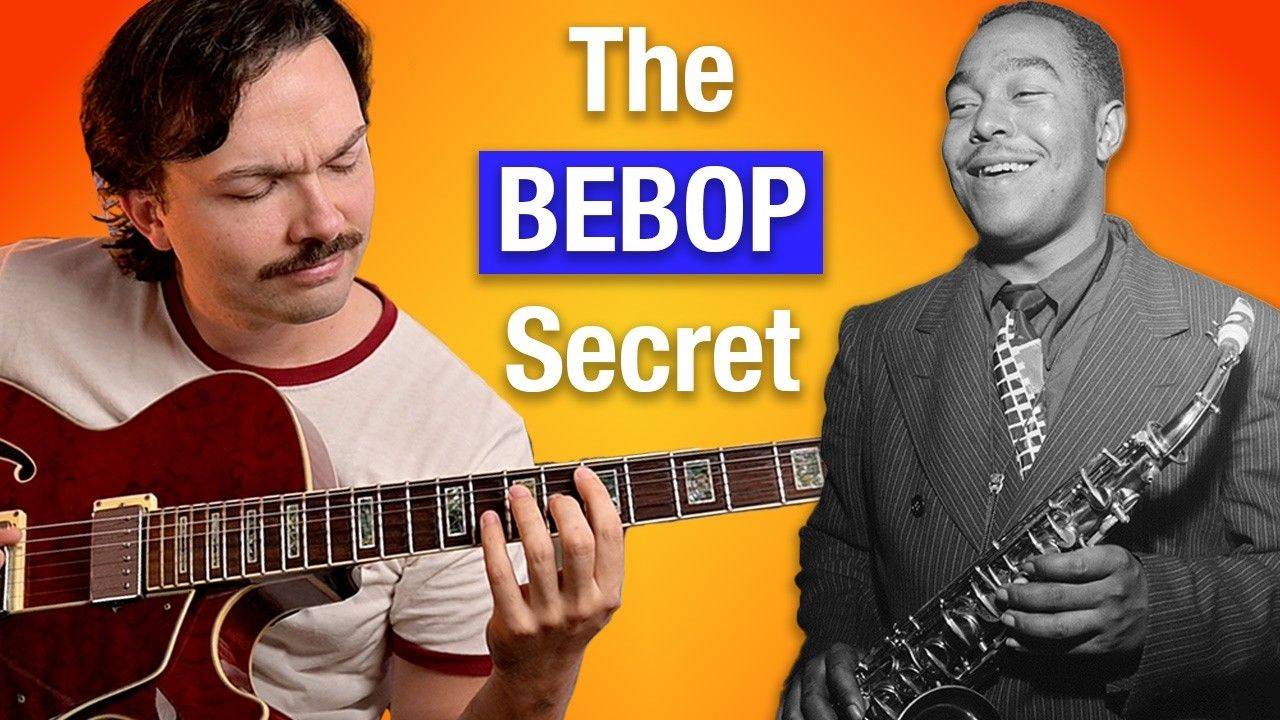
The Secret to Bebop Jazz Guitar: Chromatic Approach Patterns (Not the Bebop Scale)
Nov 05, 2026Short answer: The secret to bebop jazz guitar, in one word, is chromaticism; in three words, targeting notes chromatically. Instead of running scales in strict 3rds, approach each 3rd from a half step below on the way up, and from further below on the way down. Charlie Parker does this in his Donna Lee solo over a ii-V-I to C. What a lot of people call the bebop scale is only one small way bebop players use chromaticism: on Kim, Parker uses other chromatic patterns instead, like approaching each target note from two half steps below.
This comes from Pasquale Grasso, a great bebop jazz guitarist, and it's something Charlie Parker uses in pretty much every solo. There are some specific details to get right, so let's go through them. ▶ 0:02
| Pattern | How it works | Source |
|---|---|---|
| Ascending chromatic 3rds | Start each 3rd a half step below its first note | Pasquale Grasso masterclass ▶ 1:08 |
| Descending chromatic 3rds | Approach from further below, so you don't repeat a note | Charlie Parker, Donna Lee ▶ 2:41 |
| Bebop pattern 1 | From a chord tone, approach each next note of a descending melody from two half steps below | Charlie Parker, Kim ▶ Real Bebop Basics 4:42 |
| Bebop pattern 2 | From a non-chord tone, jump down a 4th, get to a chord tone, then come down the scale | Charlie Parker, Kim ▶ Real Bebop Basics 7:32 |
Ascending 3rds, the bebop way
Take D Dorian, as if you're playing over D-7, and play it ascending. You'll sometimes see it recommended as an exercise in 3rds. ▶ 0:39
What I recommend for this exercise of 3rds, and what Pasquale Grasso showed me in his masterclass, is chromatically adding a note to lead into each 3rd: start a half step below. The next 3rd is E to G, so you start a half step below that E. Then F to A, start a half step below the F, and so on. ▶ 1:08
You wouldn't play the whole thing as a sequence when soloing, but little bits and pieces of it sound really good. ▶ 2:07
Descending 3rds work differently
Descending, the scale in strict 3rds doesn't really sound like jazz. Some players do it (Miles Davis does it, ascending and descending, occasionally), but it's not what defines bebop language; it's borrowing more from a classical style. ▶ 2:07
This approach comes from Charlie Parker on Donna Lee. The problem: if you add one chromatic note before each descending 3rd, you get a doubled note. You end a 3rd on E, need to approach F from a half step below, and that's E again. It doesn't sound good. ▶ 3:17
So instead, approach it from further down, with more chromaticism leading into each target note. ▶ 3:43
A Charlie Parker ii-V-I lick from Donna Lee
This very common bebop-style ii-V-I lick uses both the ascending and descending chromatic 3rds. It's over D-7, G7, CMaj.7. ▶ 4:11
| Chord | Notes | What's happening |
|---|---|---|
| D-7 | D, C, B, G | descending down to the 3rd B to G |
| G7 | G♯, A, F, E♭ | chromatic approach into the 3rd A to F, then approach to E |
| CMaj.7 | E, G | the ascending 3rd E to G |
So the 3rds to focus on are B to G and A to F, descending, then E to G ascending, with chromaticism in between. ▶ 4:36
Move the lick to other chord tones
When you find a lick like this, especially with a new concept, move it around: keep the same shape, the same relationship between the notes, but start on a different chord tone of D-7. Sometimes it works, sometimes it doesn't, and sometimes you need to alter the line. It makes sure you hear the shape, and maybe you find something you like better than the original. ▶ 5:19
- Starting on the 3rd (F): kind of cool. You get the ♯11 over G7 and end on the major 7th of C. ▶ 6:05
- Starting on the 5th: if you strictly keep the shape it's okay, but the approach to F sounds weird to me, so I'd prefer going back up to G. The rest sounds good. ▶ 6:17
- Starting on the 7th: this one doesn't work. Keeping the exact shape, you end with D and F over C major. But played just over D-7 (D Dorian), not resolving to C, it's a cool approach. ▶ 6:36
There's a free PDF of this lesson: get the Secret to Bebop PDF. ▶ 7:35
Why the bebop scale is only one small piece
In a later class, Real Bebop Basics, I steelman what a lot of people call the bebop scale. Over C7, the "C dominant bebop scale" is C Mixolydian with the major 7th added, usually played descending. That lands the chord tones on downbeats: C, then B natural on the upbeat, B♭ (the 7th) on the downbeat, A, G on the downbeat, F, E (the 3rd) on the downbeat, D, C. ▶ Real Bebop Basics 0:18
People point to Charlie Parker, and there is an example of it in his solo on Kim over C7. But that's just one super small way bebop players like Parker use chromaticism. I don't even like the name "scale": people think of a scale as a collection of notes to pick from, and the way it's used correctly is a very specific way of descending in a certain order, not playing B natural randomly. ▶ Real Bebop Basics 1:48
In other spots on Kim where he could use it, he doesn't. He goes right from C to B♭ to A with no B natural, and uses other chromatic embellishments instead. They're ways of embellishing very simple melodies, like C, B♭, A, so you get more notes and more tension, which lets you play with a swing 8th-note feel. ▶ Real Bebop Basics 4:05
Bebop pattern 1: starting on a chord tone
Start on a chord tone. Over C7, start on B♭, the 7th, with a simple descending melody: B♭, A, G. Those are your target notes. ▶ Real Bebop Basics 4:42
The way Charlie Parker embellishes it: after the starting note, approach each next note from two half steps below (two frets, a whole step below) and come back up. So B♭, then G, G♯, A; then F, F♯, G. ▶ Real Bebop Basics 5:16
What's so genius about it: you start on a chord tone on the downbeat, and the last note is also a chord tone on a downbeat. The whole phrase works as an embellishment of that simple melody. ▶ Real Bebop Basics 6:19
Then practice it from each chord tone: G, F, E; then E, D, C; then C, B♭, A. Do it in this one C7 position first, then in others. ▶ Real Bebop Basics 6:46
Bebop pattern 2: starting on a non-chord tone
This one is a little trickier to visualize but just as important for descending melodies. Start on a non-chord tone, not C, E, G or B♭. Start on F (the 11th): when Parker starts on a non-chord tone, he jumps down a 4th, then gets to the chord tone. The second half of the idea just comes down the scale. If the C7 continued, you'd land on a chord tone; here you stop on the A, because maybe you're resolving at that point. ▶ Real Bebop Basics 7:32
Then do it starting from D (the 9th), and from A. ▶ Real Bebop Basics 8:46
The point: the bebop scale is a bad concept for thinking about how to improvise in a bebop style. It's one example of chromaticism, and there are many patterns and types. Learning those different ways of chromatically targeting the chord changes is what to focus on. ▶ Real Bebop Basics 9:06
Frequently asked questions
What is the secret to playing bebop on guitar?
Chromaticism: targeting notes chromatically. Approach the notes you're aiming for from a half step (or more) below, so the chord tones still land where they should.
How do you practice 3rds in a bebop style?
Ascending, start each 3rd a half step below its first note. Descending, adding one chromatic note gives you a doubled note, so approach each target from further below with more chromaticism. This comes from a Pasquale Grasso masterclass and from Charlie Parker on Donna Lee.
Do you need the bebop scale to play bebop?
No. What people call the bebop scale is one small, specific way bebop players use chromaticism. In his solo on Kim, Charlie Parker often skips it and uses other chromatic patterns, like approaching each target note from two half steps below.
What is a good Charlie Parker ii-V-I lick to learn?
The Donna Lee lick over D-7, G7, CMaj.7: D, C, B, G, then G♯, A, F, E♭, resolving to E and G. It uses both descending and ascending chromatic 3rds.
How do you make a lick your own?
Move it to start on a different chord tone, keeping the same shape. Some versions work, some need changes, and some you'll like better than the original.
Keep learning
- The first ii-V-I line to learn on jazz guitar: a bebop line with 7 ways to vary it
- How to play over ii-V-I progressions without memorizing licks: build your own lines over the changes
- How Joe Pass creates jazz lines: scale and arpeggio cells that turn into lines
Go deeper
Not sure what to work on next? Take the free Guitarist Profile quiz: 10 minutes, and you get your practice mindset, your strongest and weakest skills, and a 28-day plan. Find out what kind of jazz guitarist you are →
If you want me to guide you, that's what we do inside Chase's Guitar Academy. The Master Improvisation Blueprint gets jazz vocabulary like this into your playing, step by step, and every week we work through a tune together in the live class. You can try it free for seven days.
"I think I learned more in the first four weeks than I had in four decades of playing. It really is like a Rosetta Stone for unlocking the language of jazz." Matt Drummond, CGA member
50+ five-star reviews from CGA members, most of them on video: read what members say.
Chase Maddox is a jazz guitarist and educator in Miami and the founder of Chase's Guitar Academy. George Benson has called him "an amazing instructor." More free lessons are on his YouTube channel.
