
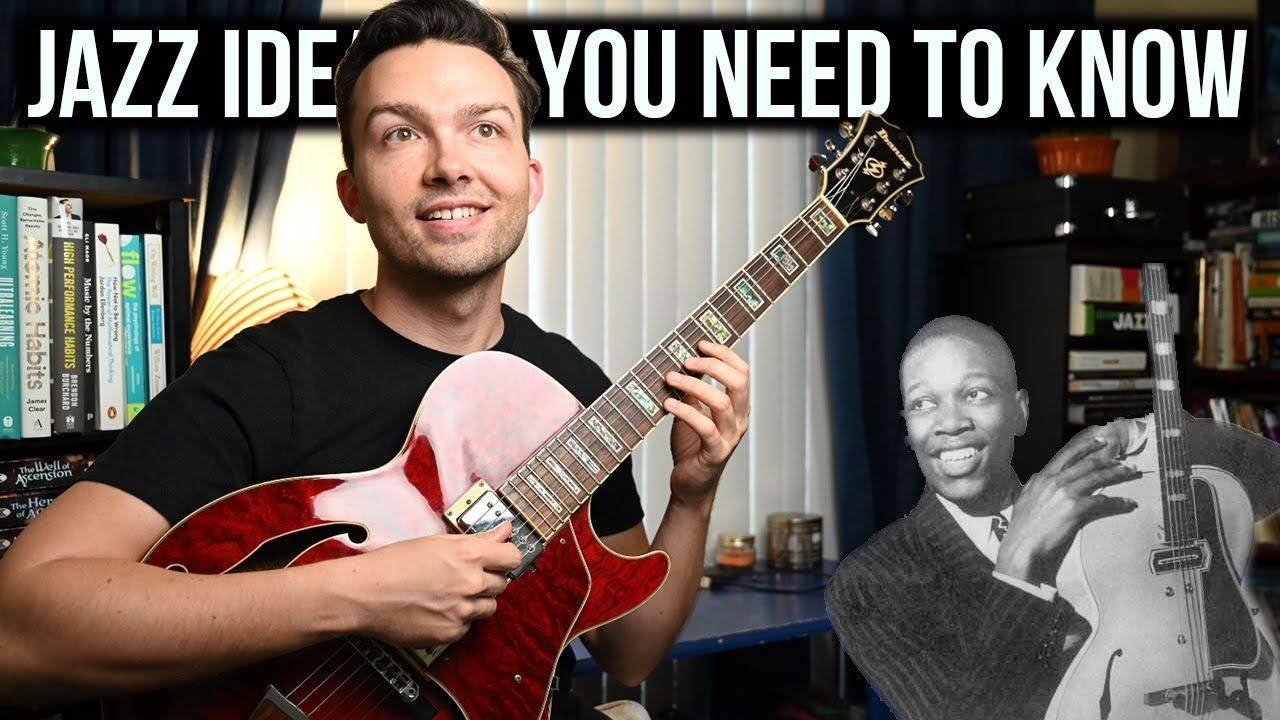
Charlie Christian's Rose Room Solo: The Major Triad Phrase and Double Chromatic Approach Notes
Nov 06, 2026Short answer: Charlie Christian's Rose Room solo (in A♭) is built on two pieces of vocabulary. The first is an iconic phrase around the major triad (A♭ here, the same shape you hear in blues like Johnny B. Goode), which he varies throughout. The second is the double descending chromatic approach: start two frets above a target note and walk down to it chromatically. He uses it to land on the 5th of a major chord, the 11th of a minor chord or the root of a dominant chord, and as glue between two lines.
Charlie Christian is widely recognized as the father of the electric guitar, and he influenced many styles, from blues to jazz. These are two key phrases from his solo on Rose Room and the different ways he varies them. They're iconic phrases that get used a lot in jazz and in blues. ▶ 0:58
| Phrase | Where in Rose Room | What it does |
|---|---|---|
| Major triad idea | around the A♭ triad, with or without the F (the 6th) ▶ 3:08 | the main phrase of the solo, varied many ways |
| Double descending chromatic: F, E, E♭ | over A♭6 | targets the 5th of a major chord ▶ 6:21 |
| Double descending chromatic into A♭ | over E♭-7 | targets the 11th of a minor chord ▶ 7:35 |
| Double descending chromatic into A♭, then G♭ | D♭6 to D♭-6 | the 5th of D♭, then the 11th of D♭ minor ▶ 8:01 |
| C, B, B♭ | over B♭7 | targets the root of a dominant chord ▶ 8:47 |
| E♭, D, D♭ | B♭7 to E♭7, and A♭7 to D♭6 | glue between two lines ▶ 9:50 |
Phrase 1: the iconic major triad idea
The first phrase is a shape around a major triad. The song is in A♭, so it's based around the A♭ triad. You've heard it in a lot of blues too, like Johnny B. Goode. ▶ 1:52
There are a few standard ways to play it; sometimes you'll see it with the F in it. Sometimes the last note is doubled (two hits), sometimes it's not. As long as you're seeing the A♭ major shape, you're in the right place. Then look at how Charlie varies it. ▶ 3:08
Variation 1, the start of the solo: still based around the same triad, but this time he starts by enclosing the third. Learn it in different positions, both around the A♭ triad shape higher up and the one lower down. ▶ 3:44
Variation 2, the last phrase of the solo: a ii-V going to A♭6: B♭-7, E♭7, A♭6, with a rest on beat one. Duplicated notes at the end of a phrase were very idiomatic of this period; you'll hear it a lot in another tune Charlie is known for, Air Mail Special. The whole phrase is based around the A♭ triad. ▶ 4:24
Variation 3, A♭6 to F7: here he targets the third of F7 (A). He starts on A♭, uses chromatic notes up to C, and plays a little triplet into the A. Over F7 you can think of it as a descending A half-diminished arpeggio: G, E♭, C, A. ▶ 5:12
Phrase 2: double descending chromatic notes
This is less a phrase than a device, a jazz vocabulary word: double descending chromatic notes. The note at the end is the target, the one you're really thinking of. Start two frets higher and walk down to it. ▶ 6:21
Variation 3 above already has it: take out the first couple of notes and you have F, E, E♭ with a rest. On A♭6 that targets E♭, the 5th. ▶ 6:21
You can use it two ways: to target a specific note of a chord, or as glue between lines, to get you into the next line you want to play. ▶ 6:58
- Over E♭-7: the first time it comes up in the solo, with that double-note ending. Here it targets A♭, the 11th of E♭ minor. ▶ 7:35
- D♭6 to D♭-6: after two beats of rest, it targets A♭, the 5th of D♭, then does it again to target G♭, the 11th of D♭ minor. So it targets the 5th on major chords and the 11th on minor chords. ▶ 8:01
- Over B♭7: at the end of a fast triplet line, C, B, B♭. So it also works to target the root of a dominant chord. Earlier in that line, just as he used an A half-diminished arpeggio over F7, here he uses a D half-diminished arpeggio over B♭7. ▶ 8:47
As glue between two lines
Going from B♭7 to E♭7 to A♭6, think of it as two phrases: phrase one over B♭7, phrase two over E♭7, and E♭, D, D♭ as the glue in between. Those notes don't land where you'd expect the strong chord tones to be, and it doesn't matter, because they connect you to the next idea. ▶ 9:50
From A♭7 to D♭6 he uses the same E♭, D, D♭. He actually hits the D on a strong beat of the D♭6, and it doesn't matter, because he eventually gets to an F, the third of D♭, and continues with a B♭-9 type of sound. ▶ 11:01
Bonus: two lines over the Secret Jazz Chord
If you've been watching my Secret Jazz Chord videos, here are two lines from this solo that work with it. ▶ 12:01
- Right at the beginning of the solo, over E♭7: the Secret Jazz Chord shape with C on top, basically an E♭13 (that specific shape). ▶ 12:01
- A triplet line over F13 going to B♭7. Moved down to E♭13 to A♭7, it works too. It's not something I would normally play, and those always make for the best learning experiences. ▶ 12:40
Learn the solo in its entirety, and these phrases will make a lot more sense. ▶ 13:32
Frequently asked questions
What key is Charlie Christian's Rose Room solo in?
A♭. The main phrase of the solo is built around the A♭ major triad.
What is a double chromatic approach?
Start two frets (two half steps) above your target note and descend chromatically to it, like F, E, E♭ to land on E♭. Charlie Christian uses it to target the 5th of major chords, the 11th of minor chords and the root of dominant chords.
What is Charlie Christian's major triad phrase?
A shape around the major triad of the key (A♭ in Rose Room), sometimes with the 6th (F) and sometimes with the last note doubled. It's the same shape you hear in blues like Johnny B. Goode, and he varies it throughout the solo.
What arpeggio does Charlie Christian play over F7?
In Rose Room, going from A♭6 to F7, he plays a descending A half-diminished arpeggio (G, E♭, C, A), targeting A, the third of F7. Over B♭7 he does the same with a D half-diminished arpeggio.
What other Charlie Christian tune uses these ideas?
Air Mail Special, where he often ends phrases with duplicated notes, as at the end of his Rose Room solo.
Keep learning
- Bebop chromaticism for jazz guitar: more chromatic approach notes from Pasquale Grasso and Charlie Parker
- Your first ii-V-I line, plus 7 variations: one line varied many ways, the way Christian varies his triad phrase
- Wes Montgomery's arpeggio ideas: arpeggio substitutions from the next generation of jazz guitar
Go deeper
Not sure what to work on next? Take the free Guitarist Profile quiz: 10 minutes, and you get your practice mindset, your strongest and weakest skills, and a 28-day plan. Find out what kind of jazz guitarist you are →
If you want me to guide you, that's what we do inside Chase's Guitar Academy. The Master Improvisation Blueprint gets jazz vocabulary like this into your playing, step by step, and every week we work through a tune together in the live class. You can try it free for seven days.
"I think I learned more in the first 4 weeks than I had in 4 decades of playing. It really is like a Rosetta Stone for unlocking the language of jazz." Matt Drummond, CGA member
50+ five-star reviews from CGA members, most of them on video: read what members say.
Chase Maddox is a jazz guitarist and educator in Miami and the founder of Chase's Guitar Academy. George Benson has called him "an amazing instructor." More free lessons are on his YouTube channel.
