
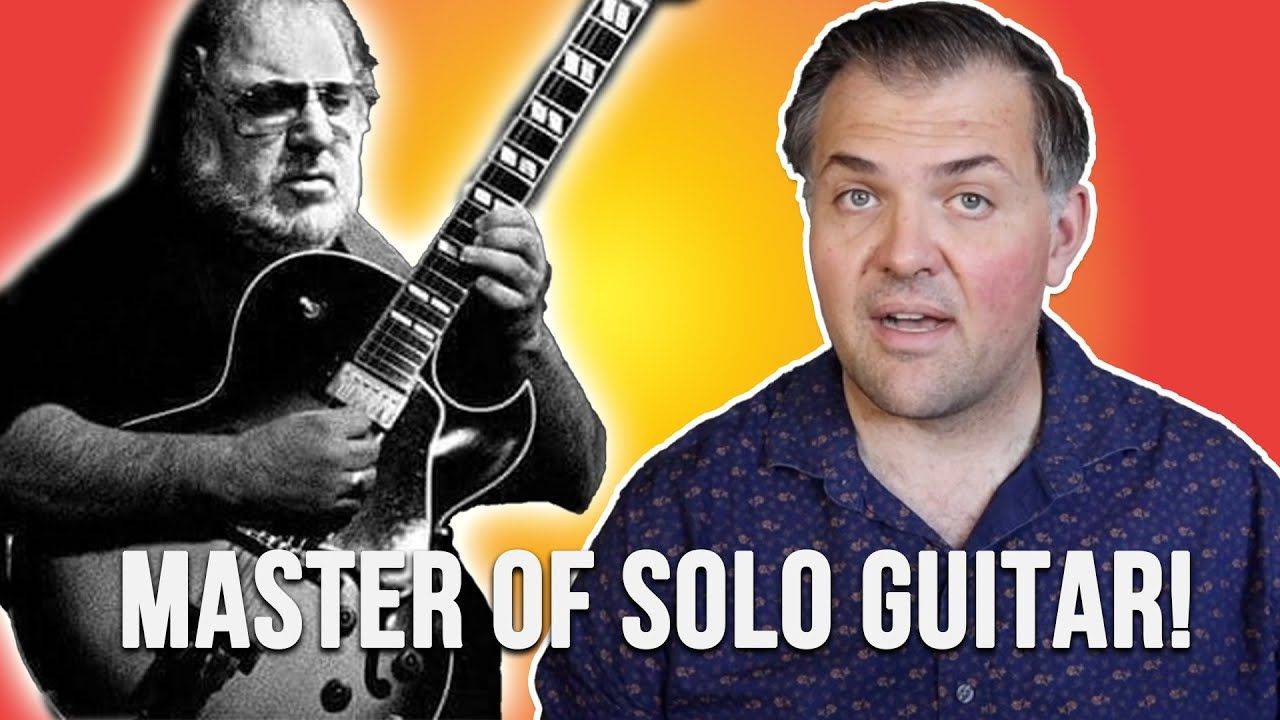
Joe Diorio's Solo Guitar Techniques: Hammer-Ons Like a Saxophone, Fourths and a Thick Pick (John Storie)
Nov 06, 2026Short answer: According to John Storie, who studied with Joe Diorio for two and a half years at USC, the three techniques behind Diorio's solo guitar playing are: hammer-ons and pull-offs in the left hand, thought of like a saxophone rather than shred technique; intervallic designs, especially stacked fourths; and a controlled right hand with a very thick pick (a 1.5 mm D'Andrea Pro-Plec) to get close to the warm attack Wes Montgomery got with his thumb.
This lesson is taught by John Storie, who studied with Joe Diorio for two and a half years at the University of Southern California, when Joe was still teaching in the studio guitar department. Joe was a legendary guitarist from the Chicago area who also lived in Miami, Las Vegas and Los Angeles. He recorded with people like Sonny Stitt and is on a very famous record, Eddie Harris's Exodus to Jazz. He passed away a couple of years before this video was made. ▶ 0:00
| Technique | What Diorio did | Why |
|---|---|---|
| 1. Hammer-ons and pull-offs | a fluid left hand instead of picking everything; staying on a turn at the top of his All the Things You Are solo ▶ 0:37 | he thought of it like a saxophone, not shred guitar ▶ 1:22 |
| 2. Intervallic designs | lots of fourths, stacked up the neck ▶ 1:59 | fourths "open up" the guitar instead of lines that are just comfortable for the fingers ▶ 2:33 |
| 3. The right hand | very thick picks (1.5 mm D'Andrea Pro-Plec), a controlled sweep across the strings ▶ 3:05 | to get the warm yet punctual attack Wes Montgomery had with his thumb ▶ 3:47 |
1. Hammer-ons and pull-offs, thought of like a saxophone
In the old Hot Licks video where Joe plays All the Things You Are, he starts right off with lines that have hammer-ons and pull-offs. ▶ 0:37
But Joe didn't think of them the way shred guitarists do. He thought of them more like a saxophone. His biggest influences in Chicago in the 50s and 60s were saxophonists. He was also close friends with Wes Montgomery, and he told John that he and Wes had lots of discussions about left-hand articulation: how important it is for a guitarist to play with a very fluid left hand and not pick everything. ▶ 1:22
A lot of the time Joe leans into an idea and stays there. Right at the beginning of his solo on All the Things You Are, he starts with a little turn and stays on that turn for a while, thinking of it like a saxophone. ▶ 1:59
2. Intervallic designs: fourths
Joe's intervallic designs are one of the most unique things about his solo guitar playing, and the one that stands out most is fourths. ▶ 1:59
Fourths are actually challenging on guitar. The strings are tuned a fourth apart, so a fourth is often two notes on the same fret: you have to barre, set your hand so you can play several notes in one area, or reach out of position for the fourth on the same string. Joe was always looking for ways to do this. He was inspired by players like McCoy Tyner and that sound, and he felt fourths let the guitar really open up, where a lot of guitarists play whatever is comfortable for their fingers. ▶ 2:33
3. The right hand: a very thick pick
Joe's right-hand technique was like watching a great classical guitarist. In John's last lessons with him, he was using really thick picks, like the D'Andrea Pro-Plec, at least 1.5 mm. ▶ 3:05
He was always trying to get the attack Wes had with his thumb, but with a pick. Joe and Wes were good friends from the same generation. He said Wes's articulation was "the most warm yet punctual articulation you could hear", and that you could imitate it with a pick, but it had to be a really thick one. In the All the Things You Are take on the Hot Licks video, you can see how he leans into the strings with the right hand. ▶ 3:47
His right hand would sweep across the strings in a very controlled way, to get more of that air sound, like a saxophone. ▶ 4:52
Joe Diorio's setup: low action, heavy strings
The strings may sound really light on his ES-175, but Joe set the action pretty low and put heavy strings on the guitar. He felt he could get more of a vibrato sound that way: when he bends or adds vibrato, he moves the string back and forth with the left hand. ▶ 4:22
He was always experimenting with his setup. He once brought a 335 to a lesson, and for a while he even had a 12-string ES-335, because he liked the chorus-like sound of all the strings working together. ▶ 4:52
He also felt that the guitar itself could do a lot of the sound production: a sound concept a lot of players had in the 60s and 70s. Instead of playing heavily into the instrument, the way Barney Kessel or Charlie Christian would have in the 1940s and 50s, you could play very lightly and let the instrument resonate and give you a beautiful, lyrical sound. ▶ 5:37
The take to study
Check out Joe's take of All the Things You Are from the Hot Licks video, where he plays his 1968 sunburst ES-175. ▶ 6:14 Watch Joe Diorio play All the Things You Are
Frequently asked questions
What are Joe Diorio's solo guitar techniques?
John Storie, his former student, names three: hammer-ons and pull-offs in the left hand thought of like a saxophone, intervallic designs built on stacked fourths, and a very controlled right hand with a thick pick.
What pick did Joe Diorio use?
In John Storie's lessons with him, very thick picks, like the D'Andrea Pro-Plec at least 1.5 mm. He was trying to get the attack Wes Montgomery had with his thumb.
Why did Joe Diorio play so many fourths?
He felt fourths let the guitar open up, instead of playing lines that are just comfortable for the fingers. He was inspired by McCoy Tyner's sound. Because the guitar is tuned in fourths, they often take a barre or a reach out of position.
What guitar did Joe Diorio play?
In the All the Things You Are take from the Hot Licks video, a 1968 sunburst Gibson ES-175. He set the action low and used heavy strings to get more vibrato.
Who studied with Joe Diorio?
John Storie studied with him for two and a half years at the University of Southern California's studio guitar department, in 2004 to 2006.
Keep learning
- Wes Montgomery's arpeggio ideas: the guitarist Diorio was trying to sound like with a pick
- Joe Pass scarpeggios: another solo guitar master's way of building lines
- How to play faster with downward pick slanting: more on right-hand technique
Go deeper
Not sure what to work on next? Take the free Guitarist Profile quiz: 10 minutes, and you get your practice mindset, your strongest and weakest skills, and a 28-day plan. Find out what kind of jazz guitarist you are →
If you want me to guide you through it, that's what we do inside Chase's Guitar Academy. The Master Standards Blueprint takes you through jazz standards step by step, with the fundamentals and lines that go with each tune, and every week we work through a tune together in the live class. You can try it free for seven days.
"I jumped in, took the trial, and saw that there were some deep dives into solo jazz guitar, as well as Wes Montgomery and George Benson and some other great things. I've not been disappointed." Mike Miller, CGA member
50+ five-star reviews from CGA members, most of them on video: read what members say.
Chase Maddox is a jazz guitarist and educator in Miami and the founder of Chase's Guitar Academy. George Benson has called him "an amazing instructor." More free lessons are on his YouTube channel.
