
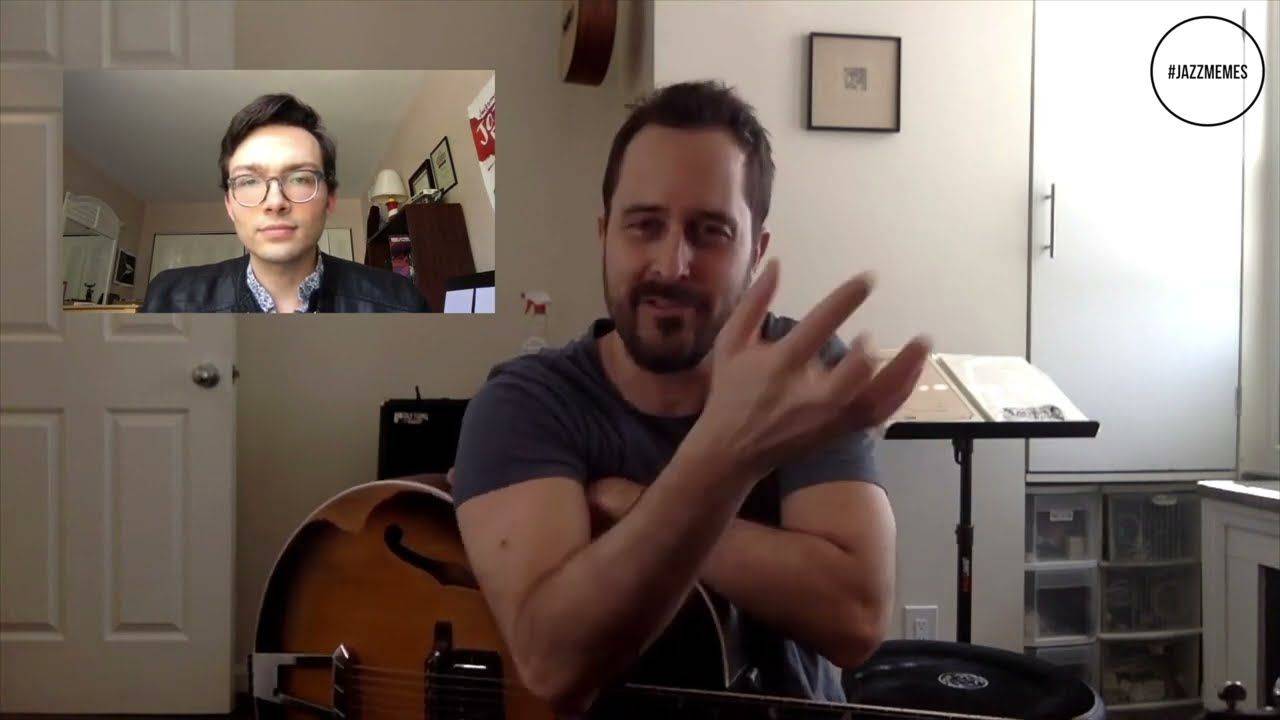
Jonathan Kreisberg on Odd Meters, Solo Guitar and What Young Guitarists Need to Work On
Nov 08, 2026Short answer: Jonathan Kreisberg feels odd meters by hearing a second pulse against the first. His tune "21" is 5+5+5+6 eighth notes, and because 21 divides by 7 he also feels it as sevens in a triplet feel; "The Lift" is 9/8 grouped 3+2+2+2, felt against 9/4 and 3/4. To him that layering is what makes odd time feel like swing, where good players hear four and six at once. For solo guitar, he starts with just a bass line and the melody, then adds chords, keeping the melody note singing. And his advice for young players: learn a lot of standards and find your own way to play them, rather than copying what's been slowed down for you online.
Jonathan Kreisberg is one of the top modern jazz guitarists playing today, with about 10 albums of his own and many more as a sideman. I talked with him in 2020 for our JazzMemes audience about his influences, his compositions, odd meters, solo guitar, and questions from viewers. ▶ 0:31
| Topic | Jonathan Kreisberg's point | Where |
|---|---|---|
| Early influences | His dad's records (Miles, Coltrane, Kind of Blue, The Who, Cream), then Eddie Van Halen, Allan Holdsworth and Coltrane | ▶ 1:01 |
| Leaving fusion | He loved Holdsworth but wanted dynamics, and melody, harmony and rhythm over texture | ▶ 6:43 |
| Composing | He avoids codifying it; a tune can start from a melody, a rhythm, a groove, a harmony or a feeling | ▶ 13:59 |
| "21" | 5+5+5+6 eighth notes, also felt as sevens in a triplet feel | ▶ 19:40 |
| "The Lift" | 9/8 grouped 3+2+2+2, felt against 9/4 and 3/4 | ▶ 28:54 |
| Advice for young players | Find your own voice, and learn a lot of standards | ▶ 39:26 |
| Solo guitar | Start with bass and melody, then add chords; let the melody sing | ▶ 47:45 |
How he got into jazz
His dad had a great record collection: Miles Davis's "'Round Midnight," Coltrane's "My Favorite Things," Christopher Parkening playing Rodrigo's Concierto, and a lot of classic rock like The Who and Cream. Then he heard Eddie Van Halen play "Eruption." Years later he followed the lineage and realized Eddie was trying to sound like Allan Holdsworth, who was trying to sound like Coltrane, so it all connected back to the records he'd grown up with. ▶ 1:01
He was always drawn to improvising, even in his rock bands at 14. The turning point came in his senior year of high school, when he moved to the New World School of the Arts in Miami and studied with J.B. Dyas, who helped him connect the theory, classical, rock and blues he'd been doing with the jazz he loved listening to. At around 16 he realized the language of the '60s records came from the '50s and bebop, and he ran with the bebop language. ▶ 4:09
Why he moved away from fusion
At the University of Miami he was still playing a Strat a lot, even on jazz gigs, and got his 175 archtop at around 18. What he realized was that what he loved was harmonically sophisticated composing and improvising, and his biggest influences were Keith Jarrett, Coltrane, Miles, Wayne Shorter, Herbie Hancock and Lennie Tristano. Holdsworth was the one thing keeping him connected to the fusion sound. ▶ 6:12
What he didn't like was the lack of dynamics: the more electrified the music, the more it changes the drummer's touch and narrows the dynamic range. He also wanted more of a blur between Holdsworth's "pianistic" side and his "singing horn" side, and he wanted to sound like a pianist, with chords and melody working like two hands on a piano. ▶ 7:45
For him, a lot of fusion shifted its focus to texture and the big picture and lost sight of melody, harmony and rhythm, the basic elements of music. He's careful to say it isn't a judgment on any style. So when he moved from Miami to New York he got rid of a lot of his gear, played little gigs, played and memorized hundreds of standards, and learned more language from the history of jazz. Since then he's been putting those elements back together in a personal way. ▶ 10:21
How he thinks about composing
Composition is the hardest thing for him to talk about. He's wary of defining his process, because codifying it could box things in. He tries to avoid a locked-in academic approach: a tune can start from a melody, a rhythm, a feeling, a groove or a harmony. ▶ 13:59
When he came up with the groove for "South of Everywhere," he didn't even know it was in five; he was playing by feel. When it came time to write it out, he wasn't sure whether to write it in five or as a bar of six and a bar of four. That's what he goes for: rhythms that feel good, but where you're not quite sure what's going on, like Chaka Khan's "Tell Me Something Good" or Led Zeppelin's "Kashmir." ▶ 16:35
How to feel odd meters: the tune "21"
His book Offerings of Note is mostly transcriptions of his heads and solos, but it has a two- or three-page primer on how to feel "21," because, like "The Lift," it has a complicated rhythm with a compound rhythm attached to it. He describes some of his tunes as almost "Afro-Balkan," borrowing the short odd phrases of Balkan music. ▶ 19:10
- The main feel: "21" is 5+5+5+6 eighth notes. ▶ 20:41
- A grounding pulse: like a jazz bar that you can feel on one and three or on two and four, every odd bar can be felt two ways. He adds a second pulse that's more complicated but actually simplifies it. ▶ 22:32
- Sevens: 21 is divisible by seven, so he takes the eighth notes into a triplet feel on seven. In his second solo on the tune, he's feeling both rhythms, and when he double-times, it's often the seven against the 21. ▶ 24:04
For more basic players, he says you can do the same thing with simpler rhythms: start simpler. ▶ 23:02
Why polyrhythm makes odd time feel like swing
The point of all this, he says, is to make odd time feel more like it should feel when you're playing in four. What makes four interesting, especially for jazz musicians, is the polyrhythmic aspect: any good jazz player swinging is hearing six and four at the same time, and with a master like Elvin Jones it's constantly there. If you play 21/8 or 9/8 only as a Balkan feel, it's cool, but to feel like the jazz world it needs that other level. ▶ 27:21
It also changes how you play lines. In 5/8 your strong beats fall in one place; feel the same bar in 5/4 and it becomes a bebop feel of duple downbeats and upbeats. So the meter you feel changes which beats you target. ▶ 33:23
"The Lift": 9/8 against 9/4 and 3/4
"The Lift" opens his album Capturing Spirits. The groove is nine, grouped 3+2+2+2. Before he brought the tune to the band, he sent everyone a sheet of rhythmic concepts, because everyone had to know how to approach it. ▶ 28:54
The challenge was moving quickly between the duple and the triple feel, and having different players in different feels at the same time. Felt as 9/8 against 9/4, the second bar always lands on an upbeat, and that's part of how the tune got its name: it "lifts." His "master key" for feeling both at once is a quarter-note triplet across two bars of 3/4. With that, you can hear three rhythms at once: 3/4, 9/4 and 9/8. ▶ 31:14
All this sounds academic, he admits, and every stage before it feels loose and comfortable is academic. Only once it feels comfortable does it become organic, and that's the goal. ▶ 37:19
What young musicians need to work on
There's so much information out there now. He tells the story of an interview where drummer Vinnie Colaiuta said the level of playing is really high because everyone can see exactly how to do things online, but that what he was mostly hearing was "a heightened level of mediocrity." ▶ 39:26
When Kreisberg was a kid, you'd hear Metheny, Holdsworth or Scofield play something and that was it; you might slow down a record or use a half-speed cassette that dropped everything an octave. Sometimes learning every note was such a pain that you'd come up with something of your own in the same realm. That struggle put more focus on finding your own voice and your own solutions, and in his view it creates more feeling and personality in the music. ▶ 40:29
The other thing: with so much stimulus, it's easy to forget the school that's always been there, learning standards. He had about 90 standards memorized by the end of high school and around 300 by the end of college. Any question about composing, improvising or music goes back to standards for him: that's where he developed his melodic sense, his sense of how harmony and melody go together, and how to tell a story. ▶ 43:34
For a beginner learning their first standards, he remembers learning tunes under pressure on gigs with older musicians, using his ears, a fingering that let him play the melody quickly, and memorizing the specific chord names. He doesn't learn them that way now, but it was part of his process. ▶ 45:41
Solo guitar: start with bass and melody
His way of learning standards with students ends up in solo guitar territory. You learn the melody, then the bass line, and then you combine just a bass note and the melody. It teaches you syncopation, and it makes you look at the melody and bass in more of a counterpoint way. You can take a simple tune and play roots and fifths under the melody. Once you have that, you add chords and phrase the melody differently. ▶ 48:17
Compared with a lot of block-chord-oriented solo guitar, he says this creates more syncopation; that's the angle he was going for on his solo album ONE. You're playing fewer notes, but it sounds like more. ▶ 49:18
Let the melody note sing
In his trio playing (like the album Trioing) and solo playing, the idea is to use chords independently from the melody, and a lot of that is rhythmic. Small things matter, like moving to a different finger so the melody note never stops singing while you reach for the next chord. ▶ 52:04
The mistake many guitar players make (and sometimes piano players) is putting the emphasis of the chords over the melody. In his words, the chords aren't there to be served by the melody; the chords are there to serve the melody. ▶ 53:42
He keeps the pick for the bass notes and plays the melody with his fingers, which gives two different tones. When Downbeat reviewed ONE, the reviewer praised the "tasteful use of overdubs of the second guitar," and Kreisberg had to write in to say there are no overdubs on that album: it's one guitar. ▶ 55:44
Frequently asked questions
How does Jonathan Kreisberg practice odd meters?
He feels a second pulse against the first. His tune "21" is 5+5+5+6 eighth notes, and he also feels it as sevens in a triplet feel; "The Lift" is 9/8 grouped 3+2+2+2, felt against 9/4 and 3/4, with a quarter-note triplet as the "master key."
Why does polyrhythm matter in jazz?
Kreisberg's point is that good jazz players swinging in four are hearing four and six at the same time. Layering pulses in odd time is what makes it feel organic, the way swing does, instead of academic.
How do you start playing solo jazz guitar?
Kreisberg starts with just a bass line and the melody, for example roots and fifths under a simple tune. That teaches syncopation and counterpoint; then you add chords, keeping the melody note singing.
What does Jonathan Kreisberg say young guitarists need to work on?
Finding their own voice instead of copying what's been slowed down and explained online, and learning a lot of standards. He had about 90 memorized by the end of high school and around 300 by the end of college.
What is Jonathan Kreisberg's book?
Offerings of Note: mostly transcriptions of his tunes and solos, plus a primer on how to feel the rhythms of his tune "21."
Keep learning
- The first 50 jazz standards to learn (in order): where to start on Kreisberg's advice to learn a lot of tunes
- Joe Diorio's solo guitar techniques: another master's approach to solo jazz guitar
- The 4 jazz standards that teach you most of jazz harmony: how tunes teach harmony and melody together
Go deeper
Where are you in your jazz journey? Take the free Guitarist Profile quiz: 10 minutes, and you get your practice mindset, your strongest and weakest skills, and a 28-day plan. Find out what kind of jazz guitarist you are →
If you want me to guide you through learning standards, that's what we do inside Chase's Guitar Academy. The curriculum tells you what to practice each day, and every week we work through a tune together in the live class. You can try it free for seven days.
"About a month ago I decided to try the free week trial — and in the first week I was able to learn a jazz standard: the melody, the progression, and an improv." Mitch Hennessey, CGA member
50+ five-star reviews from CGA members, most of them on video: read what members say.
Chase Maddox is a jazz guitarist and educator in Miami and the founder of Chase's Guitar Academy. George Benson has called him "an amazing instructor." More free lessons are on his YouTube channel.
