
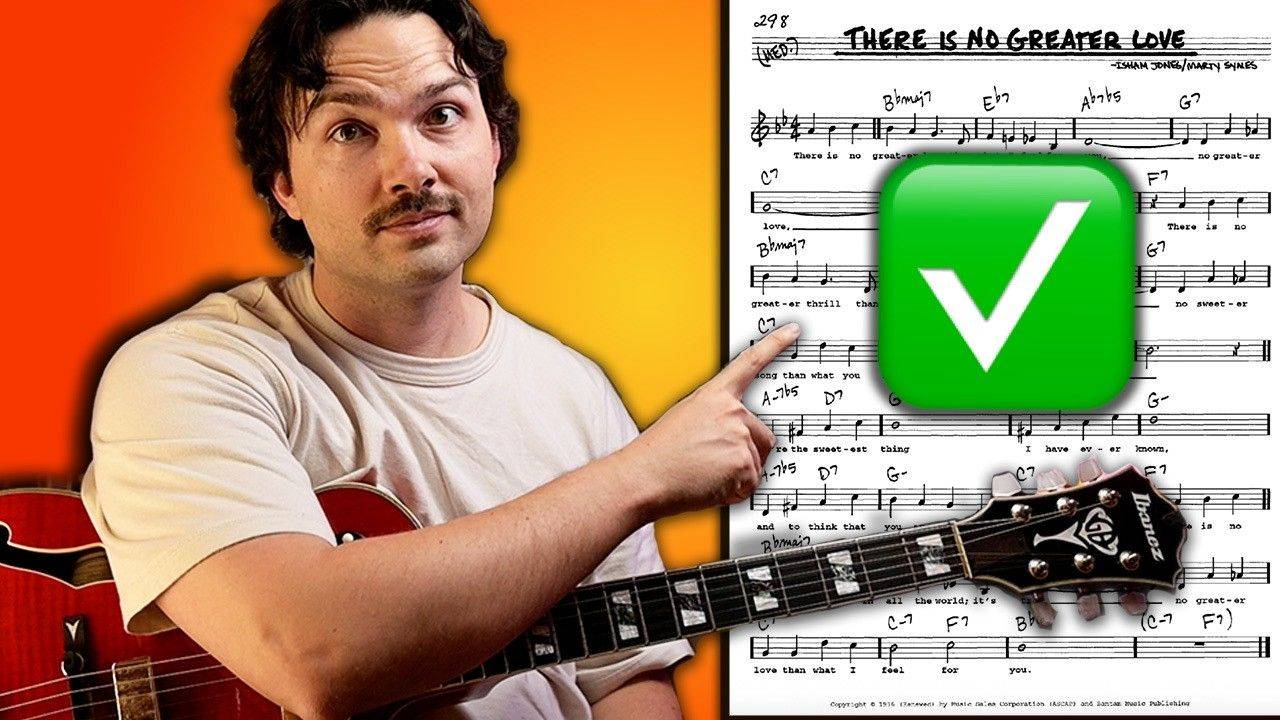
The 4 Jazz Standards That Teach You Most of Jazz Harmony (and the Order to Learn Them)
Oct 16, 2026Short answer: Learn There Is No Greater Love, What Is This Thing Called Love, There Will Never Be Another You and Days of Wine and Roses, in that order. I analyzed the chord progressions of more than 100 jazz standards, and together these four tunes cover the four core chord qualities and the most common progressions (ii-V-Is, minor ii-Vs and secondary dominants) you'll meet in about 90% of the tunes you'll ever learn.
The problem: collecting tunes instead of building a system
Most guitarists learn whatever tune they're told to: Autumn Leaves, All the Things You Are, maybe Stella by Starlight. You learn one tune after another, you still have trouble remembering them, and every new tune feels like starting from scratch.
The fix is to pick a set of tunes that, between them, contain the most common chord qualities and the most common chord progressions. Then every hour you practice transfers to hundreds of other standards. ▶ 1:12
The four chord qualities: major 7, minor 7, dominant 7 and minor 7♭5 (half-diminished).
The progressions that show up everywhere: ii-V-Is (major and minor) and secondary dominants.
One number from the analysis surprised people: dominant 7 chords are the most common chord type in jazz. They appear in 95% of the standards I analyzed, compared with 89% for major 7 chords and 91% for minor 7 chords. ▶ 3:32
The "accordion" order
The order matters as much as the tunes. I call it the accordion method: expand, then contract. ▶ 2:22
- Expand: a tune with lots of new chords.
- Contract: a tune with only a few new chords but trickier progressions.
- Repeat.
This keeps you learning new chord vocabulary without overloading you, and each tune fills a gap the one before it left.
| # | Tune | Phase | New chords | What it trains |
|---|---|---|---|---|
| 1 | There Is No Greater Love | Expand | 10 | Circle-of-fifths movement, dominant chords, B♭ |
| 2 | What Is This Thing Called Love | Contract | 4 | ii-V-Is into different keys, minor ii-Vs |
| 3 | There Will Never Be Another You | Expand | 7 | The 3 most common ii-V-Is and the 3 most common secondary dominants |
| 4 | Days of Wine and Roses | Contract | 5 | ii-V-Is moving in minor 3rds, fast minor ii-Vs, root movement outside the cycle |
1. There Is No Greater Love: your circle of fifths workout
This tune gives you the most new chords of the four (10) and a lot of dominant 7 chords. The A section is mostly root movement around the circle of fifths: B♭Maj.7 to E♭7 to A♭7, down a half step to G7, then C7 – C-7 – F7 and back to B♭. ▶ 4:07
Circle-of-fifths movement is the foundation of Western harmony, and B♭ is one of the most common keys in the standard repertoire.
2. What Is This Thing Called Love: breaking the "play in the key" habit
Only four new chords, but harder progressions. The tune is almost entirely ii-V-Is, and they go to different keys, so you can't get through it by playing in one key. ▶ 5:43
It's also one of the best tunes for practicing minor ii-Vs, which most guitarists struggle with. And in one spot a minor ii-V resolves to C major instead of the C minor you'd expect, which trains your ear not to assume.
It also contains C-7 – F7 – B♭Maj.7, the most important ii-V-I in the set.
3. There Will Never Be Another You: the Swiss Army knife
Seven new chords, and the tune has nearly everything: ii-V to the I, ii-V to the IV, and the three most common secondary dominants (II7, ♭VII7 and III7), plus a iii-vi-ii-V turnaround. ▶ 6:56
Most chords last one or two bars, so there's room to develop ideas, until the end, where the harmony speeds up.
4. Days of Wine and Roses: the final exam
Five new chords in F, which is the most common key for jazz standards. ▶ 8:00 This is where everything you've learned combines in more sophisticated ways:
- ii-V-Is that move in minor 3rds (G-7–C7, then up to B♭-7–E♭7).
- Minor ii-Vs that last two beats per chord instead of a full bar.
- Root movement that breaks the circle-of-fifths pattern.
- ii-V to ii, ii-V to iii, and a iii-vi-ii-V-I.
If you can play through this tune smoothly, you have a working command of jazz harmony.
Is this the right list for beginners?
No. These four tunes are for players ready to take improvisation and chord knowledge to the next level. If you're starting out, begin with tunes that have only two chords and build up one new chord at a time. That's how the Master Standards Blueprint inside Chase's Guitar Academy is sequenced. ▶ 10:20
Frequently asked questions
What are the most important jazz standards to learn?
For harmony, the four that cover the most ground are There Is No Greater Love, What Is This Thing Called Love, There Will Never Be Another You and Days of Wine and Roses. Between them they contain all four core chord qualities and the most common ii-V-I and secondary-dominant progressions.
What order should I learn jazz standards in?
Alternate between a tune with many new chords and a tune with few new chords but harder progressions. That keeps the workload manageable while each tune fills gaps the last one left.
What is the most common chord in jazz?
The dominant 7 chord. In an analysis of more than 100 standards, dominant 7 chords appeared in 95% of tunes, slightly more often than major 7 (89%) or minor 7 (91%) chords.
Are these good first jazz standards?
Not for complete beginners. Start with tunes that have very few chords, then come back to these four.
Go deeper
Not sure where you stand? Take the free Guitarist Profile quiz: 10 minutes, and you get your practice mindset, your strongest and weakest skills, and a 28-day plan. Find out what kind of jazz guitarist you are →
Inside Chase's Guitar Academy, the Master Standards Blueprint takes you from two-chord tunes through this core set, adding no more than a few new chords per tune, with weekly live classes.
"In the first week I was able to learn a jazz standard: the melody, the progression, and an improv." Mitch Hennessey, CGA member
50+ five-star reviews from CGA members, most of them on video: read what members say.
Chase Maddox is a jazz guitarist and educator in Miami and the founder of Chase's Guitar Academy. George Benson has called him "an amazing instructor." More free lessons are on his YouTube channel.
