
How Joe Pass Creates Jazz Lines: Scarpeggios on Stella by Starlight
Oct 29, 2026Short answer: Joe Pass creates many of his lines by taking a melodic cell, a small group of three to five notes, and repeating it in different octaves. The cell isn't a chord on its own, but repeated up or down the neck it works like an arpeggio. I call these scarpeggios: scales and arpeggios combined. In his Stella by Starlight solo he plays A G D B♭ over E-7♭5 and repeats it an octave lower, and over B♭Maj.7 he encloses the root and the 5th (C A B♭, G E F) and repeats that up the neck.
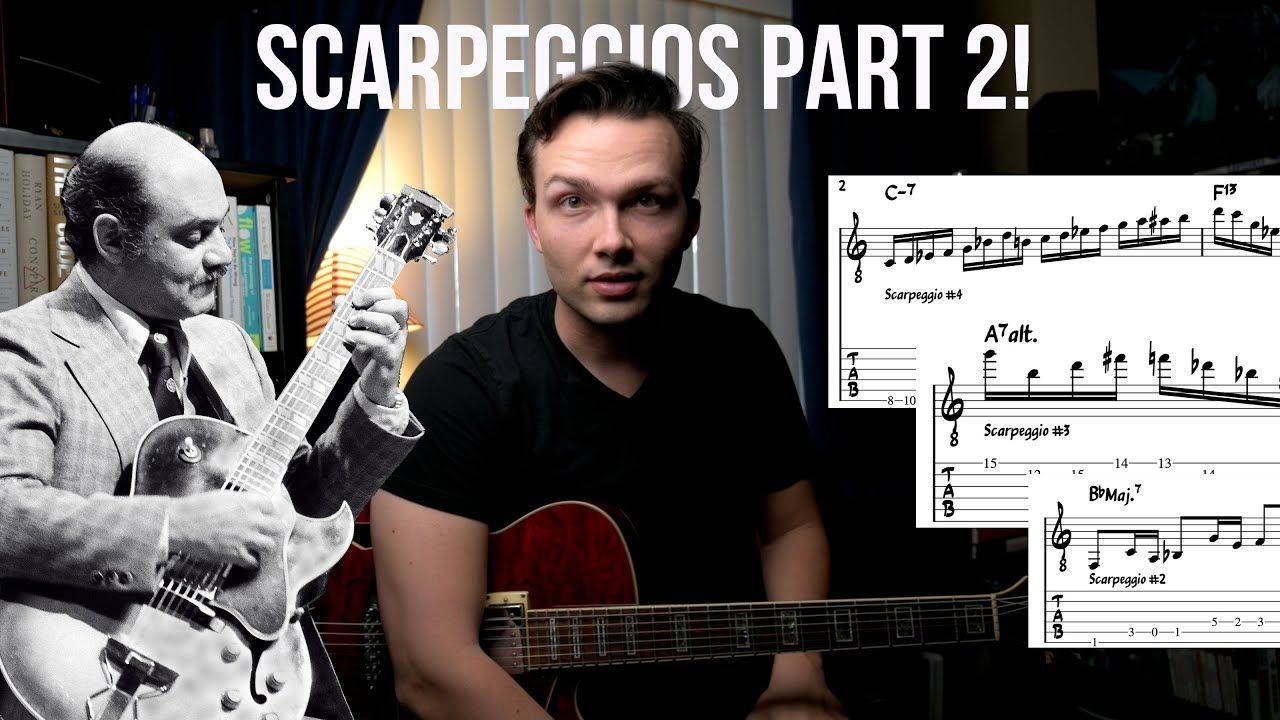
If you saw my last video on Joe Pass scarpeggios, you know the idea: Joe Pass Scales + Arpeggios takes scales and arpeggios and combines them in a certain way. Joe tends to do it with a melodic cell that he repeats over different octaves, and that creates a sort of arpeggio even though, on its own, it isn't totally a chord. ▶ 0:55
All four examples come from (or are built from) his solo on Stella by Starlight. He plays that solo a whole step up, so I transposed the phrases down to fit the original key, which is where you'll probably play it. ▶ 1:16
The four scarpeggios at a glance
| # | Chord | The cell | What's going on |
|---|---|---|---|
| 1 | E-7♭5 | A G D B♭ | Slide into F♯ (the 9th), then the cell in two octaves, resolving to A |
| 2 | B♭Maj.7 | C A B♭ · G E F | Enclose the root, then the 5th, and repeat up the neck |
| 3 | A7alt | G B D F♯ · F D♭ B♭ A♭ | My own cell built from part of Joe's phrase, resolving to A |
| 4 | C-7 to F7 | G B♭ D B | Notes off a G minor triad plus B natural, then linking into #1 moved up for F7 |
Scarpeggio #1: E-7♭5
Joe plays this off the secret jazz chord shape (here's that video). He starts by sliding into F♯, the 9th, which gives it that melodic minor sound. Then comes the melodic cell: A G D B♭, and then A G D B♭ again in the next octave down, resolving to A. ▶ 1:42
That little slide into F♯ is how he decorates the start of the line. Once you have the cell, it's the same four notes in each octave.
Scarpeggio #2: B♭Maj.7
This one works over a major chord and it's a really nice pattern. You can think about it as an enclosure, but it's basically enclosing the root of the chord and then enclosing the 5th. ▶ 2:42
Over B♭Maj.7 he starts on F, then plays C A B♭ (enclosing the root, B♭), then G E F (enclosing the 5th, F), and keeps repeating C A B♭ G E F as he goes up the neck.
Scarpeggio #3: A7alt, and how to make your own
A7 altered could be the second bar of Stella by Starlight. Joe plays a phrase here that continues into a cool augmented idea. Leave the augmented part for later and just take the first part of the phrase. ▶ 3:23
This time I use the scarpeggio concept to create my own version. Joe doesn't play this one directly, but it uses parts of his phrase. Repeat it in two octaves: ▶ 3:48
G B D F♯, F D♭ B♭ A♭, resolving to A.
You could think of the first four notes as GMaj.7 and the next four as B♭-7, but I'd rather remember the shape and really feel it instead of remembering the analysis. I think that's easier to apply. Then move it around, and link it to the A altered shape you're used to playing, so you can see where the starting note sits over that chord. ▶ 4:52
Scarpeggio #4: C-7 to F7
Over C-7, Joe goes up in small groups of scale notes (1, 2, 3, then 1, 2, 3, 4) and then plays notes off a G minor triad, G B♭ D, followed by B natural, and repeats that pattern. ▶ 5:19
Then I link it to Scarpeggio #1. I take the same shape we used for E-7♭5, move it up for F7 (on the chart it becomes F13), slide into it, and continue the line to resolve to F minor. If you aren't familiar with the secret jazz chord process I learned from my teacher Barry Greene, check out that video first and this will make more sense. ▶ 5:54
Get the PDF
Obviously I need to practice these a little bit too. The notation for all four is in the free PDF: download the Scarpeggios lesson PDF. ▶ 6:38
Frequently asked questions
What is a scarpeggio?
A scarpeggio combines a scale and an arpeggio. Joe Pass takes a melodic cell of three to five notes and repeats it in different octaves, so it works like an arpeggio even though the cell isn't a chord on its own.
How did Joe Pass create his lines?
One way he built lines was by repeating small melodic cells over different octaves and decorating them with slides and enclosures. In his Stella by Starlight solo he plays A G D B♭ over E-7♭5 in two octaves, and encloses the root and the 5th over B♭Maj.7.
What is an enclosure on a major 7 chord?
Approaching a chord tone from above and below. Over B♭Maj.7, Joe Pass plays C A B♭ (enclosing the root) and G E F (enclosing the 5th), then repeats it up the neck.
What key did Joe Pass play Stella by Starlight in?
In the solo these phrases come from, he plays it a whole step above the original key. The examples on this page are transposed down to the original key.
How do I make my own scarpeggio?
Take part of a phrase you like, pick a small group of notes from it, and repeat it in two octaves. Then link it to a chord shape you already know and move it around the neck.
Keep learning
- How to play over ii-V-I progressions without memorizing licks: another way to build your own lines instead of memorizing licks
- Pat Martino's minor conversion, explained: another legend's way of simplifying the chords under a line
- Corey Christiansen's two shapes for scales and arpeggios: simple fingerings for playing these cells across the neck
Go deeper
Not sure which skill to work on next? Take the free Guitarist Profile quiz: 10 minutes, and you get your practice mindset, your strongest and weakest skills, and a 28-day plan. Find out what kind of jazz guitarist you are →
If you want to dig into players like Joe Pass with someone guiding you, that's what we do inside Chase's Guitar Academy: you learn jazz standards step by step and we work through a tune together in the weekly live class. You can try it free for seven days.
"If you decided hey you know what I just want to learn how to play like my hero whether it's George Benson, Wes Montgomery, Charlie Christian, Grant Green, Joe Pass, Pat Martino - you can do that at the academy. Not just learn licks or learn their favorite passages or tricks, you get a chance to take a deep dive into their style, their choice of notes, what makes each artist different from the other." Roger Cooper, CGA member
50+ five-star reviews from CGA members, most of them on video: read what members say.
Chase Maddox is a jazz guitarist and educator in Miami and the founder of Chase's Guitar Academy. George Benson has called him "an amazing instructor." More free lessons are on his YouTube channel.
