
Jazz Guitar Scale and Arpeggio Shapes: Corey Christiansen's Two-Shape Alternative to CAGED
Oct 24, 2026Short answer: Corey Christiansen's two-shape system replaces the five CAGED shapes with two fingerings for every scale and every arpeggio. Pattern 1 is the first octave of what CAGED calls the E shape, and Pattern 2 is the G shape. You learn each one a single octave at a time, the way pianists learn scales, and you cover more of the neck by shifting and starting the same fingering over again. Fewer options means less to think about when you're improvising.
Corey Christiansen has taught a lot of classes for us inside Chase's Guitar Academy, and this is one of the ideas members bring up most. A lot of them told me it made things so much simpler when they were learning ii-V-I licks and other ideas for jazz improvisation. This clip is from one of his masterclasses. Everything below is Corey's method, in his words as much as possible. ▶ 0:00
Two shapes instead of five
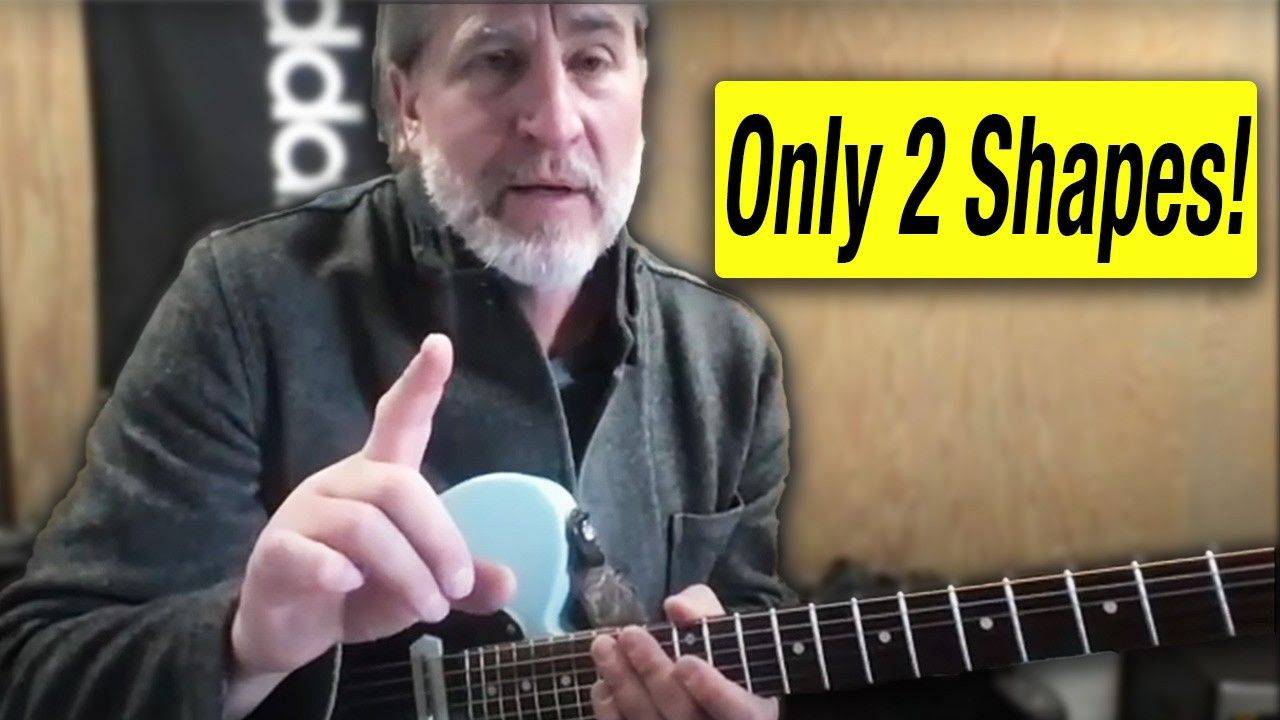
Corey only has two ways of fingering any scale or arpeggio. "I only have two shapes," he says, and he doesn't think about anything else. ▶ 0:37
His first shape, shown on a C scale, is the first octave of what most CAGED players would call the E pattern.
| CAGED system | Corey Christiansen's two-shape system | |
|---|---|---|
| Shapes per scale or arpeggio | 5 | 2 |
| How much you learn at once | Usually two octaves | One octave |
| Shape 1 | E shape (one of five) | Pattern 1 = first octave of the E shape |
| Shape 2 | G shape (one of five) | Pattern 2 = the G shape |
| Covering more of the neck | Learn the next shape | Shift and start the same fingering over |
| Where to play a line | Five or more options | "I have two options. That's it." |
Why one octave at a time
Corey only teaches one octave at a time. His reasoning comes from piano: piano teachers start you on one octave, with a fingering where the thumb crosses under to keep the scale going. On guitar, we usually start with two-octave scales, which is twice as much information on an instrument that's already harder to see than the piano. When he asks why guitarists do it that way, he says nobody has ever given him a good answer. ▶ 1:08
"One octave is easier than two," he says. "It's actually twice as easy." ▶ 3:29
Connecting octaves: shift and start over
Once you have the one-octave fingering, you play the next octave with the same shape starting on the fourth string. There's a small shift there, which Corey jokingly blames on how the guitar's tuning was put together, but the fingering can stay exactly the same. ▶ 2:14
To connect octaves, he does what pianists do: shift under, then start the fingering over again. That's why it's a big deal. With one shape and one shift, a two-octave arpeggio is easy, and so is three octaves. ▶ 2:49
So he doesn't start with the five or six standard fingerings from the CAGED system. He learns one octave and moves it. ▶ 3:29
Building arpeggios by addition
Inside the shape, Corey starts to see 1, 3, 5 (the triad). To make it a seventh chord, you add one note. ▶ 3:29
He thinks of it as addition and multiplication. You add one note, then multiply it across your fingering. From there he takes the one-octave arpeggio around the circle of fourths, starting in C. ▶ 4:08
Pattern 2: the G shape
That's Pattern 1. Pattern 2 is what CAGED calls the G shape. ▶ 4:42
You could play it with a stretch, but Corey doesn't. When the scale moves to the fifth string, he keeps the same finger, so he doesn't have to shift. On the fourth string he does change the fingering a little, and it makes more sense to just shift there. ▶ 5:14
Mixing the two patterns across the neck
Here's what Corey calls the brilliance of it: once you have both patterns, you connect them. To play a two-octave scale, he strings the patterns together, one octave after another. ▶ 5:51
That reduces all the information. You learn two patterns and move them around the fretboard. Instead of choosing between five, six or twelve places to play something, you have two.
Why fewer shapes helps your improvising
Corey ties this to the "brain freeze" most of us know. You have so many ideas and so many options for where to play them that you start thinking about how to get to the line, and then the line's gone. Now G7 is here, you panic, and you never make it to the resolution on C. It's happened to everyone, including Corey. When he asked me if it had happened to me when I was younger and still developing my language, I said yes, of course. ▶ 6:43
His point as a teacher: being a better teacher doesn't mean explaining things in a more advanced, complicated way. It means explaining them more simply. ▶ 7:17
And it may not be as much information as you think. It just feels like it is, maybe because you've told yourself it's a lot. Corey's example: "Joe Pass isn't playing that much information." He's playing variations of fundamentals. ▶ 7:53
Frequently asked questions
Is there an alternative to the CAGED system for jazz guitar?
Yes. Corey Christiansen uses just two fingerings for every scale and arpeggio: Pattern 1, the first octave of the CAGED E shape, and Pattern 2, the G shape. He learns each one octave at a time and connects octaves by shifting and restarting the same fingering.
Do you need to learn all five CAGED shapes?
Not with Corey's approach. He covers the neck with two one-octave shapes that he moves around the fretboard, so you're choosing between two options instead of five or more.
Should I learn scales one octave or two octaves at a time on guitar?
Corey teaches one octave at a time, the way pianists do. One octave is half the information, and once you have it you can play two or three octaves by shifting and starting the fingering over.
How do you play a two-octave arpeggio on guitar without a new shape?
Play the one-octave shape, shift, and start the same fingering again on the next root. Corey uses that to play two- and three-octave arpeggios with a single shape.
Why do I freeze up when improvising over a ii-V-I?
One reason Corey gives is having too many options. If you're deciding between five or more places to play a line, the line is gone by the time the G7 arrives. With only two shapes there's much less to think about.
Keep learning
- How to play over ii-V-I progressions without memorizing licks: putting these shapes to work over ii-V-Is
- How to play faster: downward pick slanting for jazz lines: picking these lines faster
- How to practice jazz guitar in 30 minutes a day: fitting it into 30 minutes a day
Go deeper
Not sure which skill to work on next? Take the free Guitarist Profile quiz: 10 minutes, and you get your practice mindset, your strongest and weakest skills, and a 28-day plan. Find out what kind of jazz guitarist you are →
The rest of this masterclass is inside Chase's Guitar Academy, along with Corey's first masterclass with us, Jazz Guitar Fluency, and his other masterclasses. You can try it free for seven days.
"It's been fantastic for me really as far as getting to know all the different positions when you're playing jazz and how they lay out on the neck, and really associating certain lines with certain voicings and positions on the guitar." Michael B., CGA member
50+ five-star reviews from CGA members, most of them on video: read what members say.
Chase Maddox is a jazz guitarist and educator in Miami and the founder of Chase's Guitar Academy. George Benson has called him "an amazing instructor." More free lessons are on his YouTube channel.
