
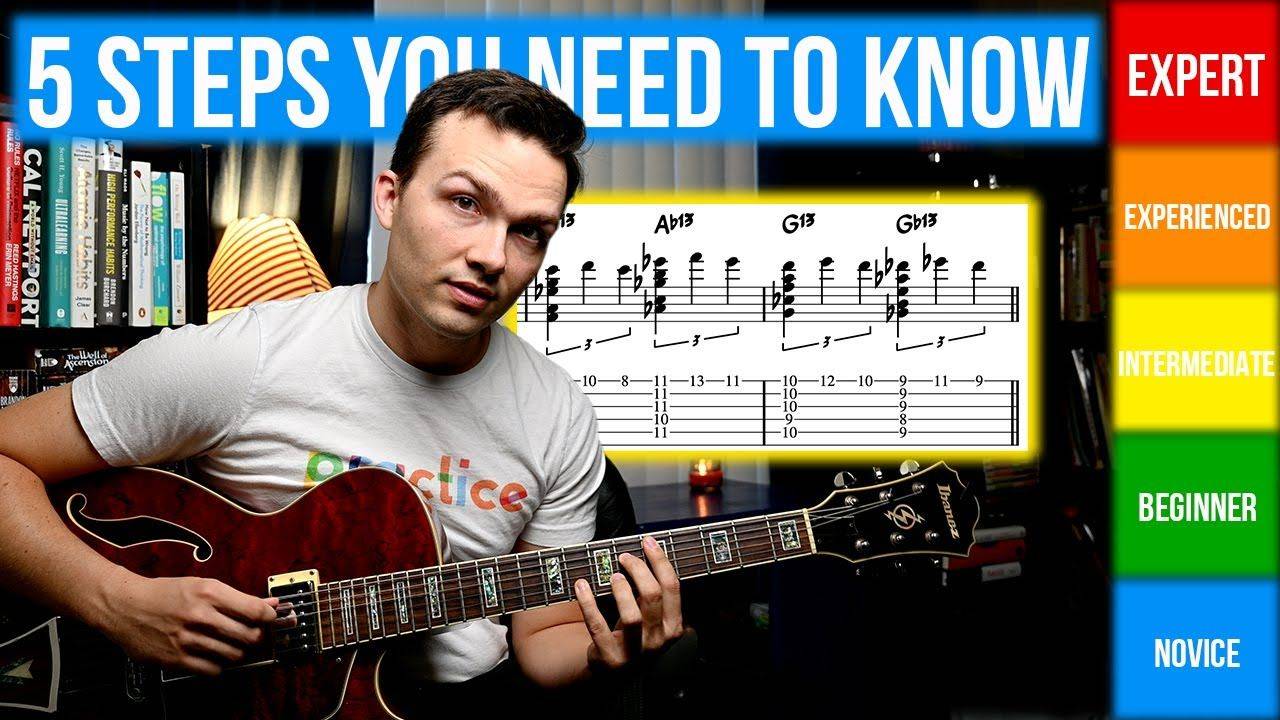
How to Comp a Jazz Blues on Guitar: 5 Levels From Standard to Expert
Nov 09, 2026Short answer: You can take an F jazz blues from standard to expert in five levels, all with one voicing, the secret jazz chord. Level 1 is the standard changes with 13th chords and altered chords (♯9 on top). Level 2 replaces the diminished chord in bar 6 with G7alt. Level 3 adds tritone subs (B13, D♭13, A♭13, F♯7alt), level 4 adds melodic voice leading on top of the chords, and level 5 turns the first three bars into an F7sus♭9 vamp. Expert level doesn't mean playing all of these at once: they're options to pick from, chorus to chorus.
In this video we build up your jazz blues playing in five levels, starting from standard jazz voicings with the secret jazz chord idea and ending at a complex, expert-level jazz blues. I'm assuming you already know the basic blues form, so we start at the jazz blues. You can follow along with the free PDF. ▶ 0:11 ▶ 1:14
| Level | What changes | Example in F |
|---|---|---|
| 1 | The standard jazz blues with the secret jazz chord: 13 on top, ♯9 on top for altered chords, 9 on top for minor | F13, B♭13, F7alt, B°, D7alt, G-9, C7alt ▶ 1:38 |
| 2 | Think of the diminished chord in bar 6 as a dominant chord | G7alt instead of B° ▶ 4:03 |
| 3 | Tritone subs | B13, D♭13, A♭13, F♯7alt ▶ 5:33 |
| 4 | Melodic voice leading: a melody on top of your chords | Whole-step melody notes, a minor 3rd move, a tritone-sub turnaround ▶ 8:45 |
| 5 | A sus♭9 vamp | F7sus♭9 for the first three bars ▶ 11:30 |
Level 1: the standard jazz blues with the secret jazz chord
We're in F. For a lot of these secret jazz chord voicings I use the 13th as the top note, and I add the root so you hear it more as a blues. ▶ 1:38
- F13, then the IV chord, B♭13, then back to F13. ▶ 1:56
- In bar 4 you'll sometimes see a ii-V, C-7 to F7, or F altered to B♭. We take out the C minor and just play F7alt. For the altered sound, the secret jazz chord uses the ♯9 instead of the 13, and F7alt slides really nicely into the next chord, B♭13. That's why it works so well. ▶ 2:08
- After B♭13, the second line of the blues is usually where you'd see a diminished chord: B°. Then back to F13. ▶ 2:31
- Then the VI dominant chord, setting up the last four bars: D7alt. Again the ♯9 on top, so the top note is F. ▶ 2:55
- The last line starts on G minor. You could think Dorian here, but to practice the secret jazz chord, I take the 9th of the chord, so for G minor I'm looking at the A. You could also think of this as just C13. ▶ 3:10
- Then C7alt, thinking of the E♭ as the secret jazz chord note, back to F, and at this level the turnaround is just the V chord: C7alt. ▶ 3:30
| Bars | Level 1 chords (F blues) |
|---|---|
| 1–4 | F13, B♭13, F13, F7alt |
| 5–8 | B♭13, B°, F13, D7alt |
| 9–12 | G-9, C7alt, back to F, C7alt (turnaround) |
That's our basis for the blues. From here we start making changes. ▶ 3:47
Level 2: think of the diminished chord as a dominant chord
Level 2 gives us options for the diminished chord in bar 6, B° in this key. Instead of thinking of it as a diminished chord, we can think of it as a dominant chord. ▶ 4:03
The way I translate it: whatever the root is, here B, I think of it as the 3rd of a dominant chord. B is the 3rd of G7, and then we can use an altered chord: G7alt. So after B♭13 we play G7alt instead of B°, with B♭ as the top note, and then back to F. ▶ 4:22
Why does G7alt resolve to F13? Don't think of it as F13, think of it as C minor. Put a C in the bass and keep the same voicing, and you get a C-6/9 voicing. G7alt is the V of C, so that's why it sounds like it works going into that chord. ▶ 4:55
Level 3: tritone subs
You've probably seen tritone subs on YouTube. They're a little more advanced than you might think at first, and they can give you some really cool sounds. A tritone sub means you take the root and move it up or down a tritone (it's the same either way). ▶ 5:33 ▶ 6:08
It switches a V-I relationship into a chromatic relationship. In bar 4, F7alt to B♭ is a V-I. The tritone sub of F is B, so B13 to B♭13 moves by half step. It's still the same secret jazz chord voicing; I switch its position so I can get the bass note. ▶ 6:08
| Bar | Level 1–2 chord | Tritone sub |
|---|---|---|
| 4 | F7alt | B13 ▶ 6:08 |
| 6 | G7alt (level 2) | D♭13 ▶ 6:53 |
| 8 | D7alt | A♭13 ▶ 7:15 |
| 10 | C7alt | F♯7alt, resolving to F13 ▶ 7:32 |
So bars 5–7 become B♭13, D♭13, F13, and the last line goes A♭13, G-9, F♯7alt, F13. For the F♯7alt I keep the same voicing as G-9 and change the bass note. It's kind of a dark way to get to F13, but you get this really nice chromatic motion. ▶ 6:53 ▶ 7:32
Don't play every level at once
You don't have to use all of these options in one chorus. They're options, so that when you play through a blues you don't feel like you're playing the same thing every chorus. You should be able to play 30 to 50 choruses of a blues without repeating yourself, and respond to what the soloist is doing, whether they're playing over the tritone subs or the diminished chord. Expert level isn't playing all of these at the same time. It's picking from these options, and it's up to you as a musician to pick which ones fit. ▶ 8:07
Level 4: melodic voice leading
Level 4 is what I call melodic voice leading. For most of these secret jazz chord voicings there's an extra note you can reach a whole step away from the top note. On the F13 voicing, take your pinky off and you have the note C. With that you can create little melodies, like D down to C, and that's true for basically all of these voicings. ▶ 8:45
That makes your comping more interesting. We don't just want to play chords and harmony; we want the melody of our chords to relate to what the soloist is doing, or create its own counter melody. That's why it gets more advanced: you're doing it while also thinking about the harmony and responding to the soloist, so you have to be very comfortable with the chords first. ▶ 9:23
- Bars 5 and 6, up a minor 3rd: move the whole voicing up a minor 3rd while keeping the melody going. This is taken straight off of Joe Pass. ▶ 9:55
- Where the voicing comes from: the secret jazz chord voicing comes from Joe Pass originally. I learned it from my teacher Barry Greene, who was influenced by Joe Pass on that. My brother, a piano player, tells me it's a voicing used a lot in piano too. So we want to use it the idiomatic way, with those melodies. ▶ 10:21
- The turnaround: end the form on F13. Instead of a classic I-VI-ii-V turnaround, use tritone subs with a little melody on top: F13, A♭13 (the tritone sub of D), G minor with the same voicing, G♭ (the tritone sub of C altered), and back to F13 at the top. ▶ 10:40 ▶ 11:12
Level 5: the sus♭9 vamp
Level 5 is a cool way to use the secret jazz chord for vamps, the way I learned it from my teacher Barry Greene: as a sus♭9. For the 7sus♭9 voicing, play the secret jazz chord voicing off the root. ▶ 11:30
- Instead of F13 for the first three bars, play F7sus♭9, and you can basically alternate between the bass and the chord. ▶ 11:49
- It's a dark sound, with a more modern sound than a traditional blues. It's really cool at a climax point in your solo, or when the band's really getting into it. ▶ 12:01
- To get out of it, switch to F7alt in bar 4, which goes back to B♭13. ▶ 12:20
Frequently asked questions
What are the chords of a jazz blues in F?
In the standard version in this lesson: F13, B♭13, F13, F7alt | B♭13, B°, F13, D7alt | G-9, C7alt, F13, C7alt. Bar 4 is sometimes written as a ii-V, C-7 to F7.
What is the secret jazz chord?
A voicing that comes from Joe Pass originally; Chase learned it from his teacher Barry Greene, who was influenced by Joe Pass. On dominant chords it has the 13th on top, on altered chords the ♯9, and on minor chords the 9th, so one shape covers a whole jazz blues.
What can I play instead of the diminished chord in bar 6 of a jazz blues?
Treat its root as the 3rd of a dominant chord: B° becomes G7alt. Then you can tritone-sub that to D♭13, giving B♭13, D♭13, F13.
How do tritone subs work in a jazz blues?
Move the root of a dominant chord up or down a tritone. It turns a V-I into a half-step move: B13 to B♭13 instead of F7alt to B♭13, A♭13 instead of D7alt, F♯7alt instead of C7alt.
What is a sus♭9 chord on a jazz blues?
A dark, modern vamp sound: play the secret jazz chord voicing off the root for F7sus♭9 in the first three bars, then switch to F7alt in bar 4 to get back to B♭13.
Keep learning
- How to practice melodic minor in all 12 keys (Invitation): the secret jazz chord shape through every melodic minor key in one tune
- How Joe Pass creates lines with scarpeggios: single-note Joe Pass lines built off the same secret jazz chord shape
- Minor pentatonic substitutions in 6 levels: the same level-by-level approach, for soloing over minor 7 chords
Go deeper
Not sure what to work on next? Take the free Guitarist Profile quiz: 10 minutes, and you get your practice mindset, your strongest and weakest skills, and a 28-day plan. Find out what kind of jazz guitarist you are →
If you want me to guide you, that's what we do inside Chase's Guitar Academy. The curriculum tells you what to practice each day, and every week we work through a tune together in the live class. You can try it free for seven days.
"I'm working on some blues stuff at the minute, which is something I've always been interested in. Jazz, blues, walking through some Grant Green phrases over some blues standards… And I really highly recommend it." Andy, CGA member
50+ five-star reviews from CGA members, most of them on video: read what members say.
Chase Maddox is a jazz guitarist and educator in Miami and the founder of Chase's Guitar Academy. George Benson has called him "an amazing instructor." More free lessons are on his YouTube channel.
