
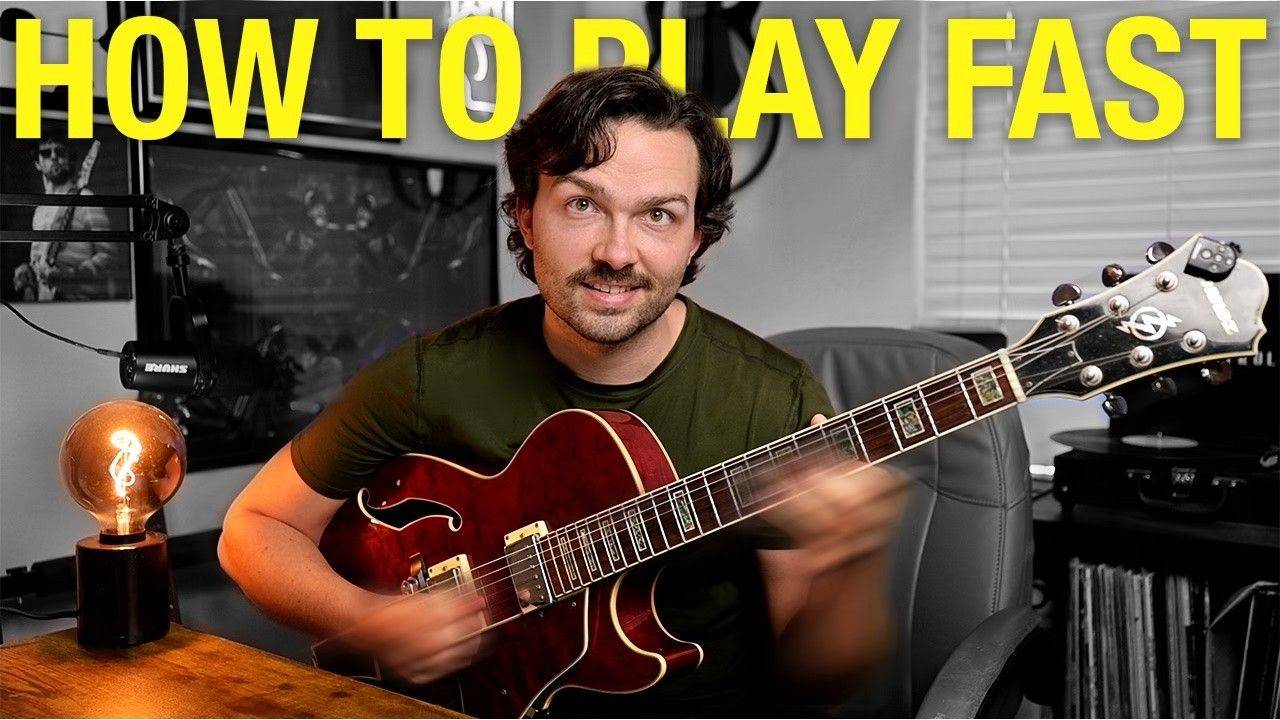
How to Play Fast Jazz Lines Like George Benson: One Four-Note Pattern, Four Measures Long
Nov 08, 2026Short answer: There are two reasons most people can't play fast: a technical one (right- and left-hand mechanics) and a mental one (you can't play what you can't hear). This lesson fixes both with one four-note pattern, C♯, C, B♭, A, played over D minor. Pick it down-up so you always end on an up stroke, use a pull-off when a string has an odd number of notes, and play down-down-down when you move to a higher string. Then lead into the pattern with a D minor arpeggio, and link D minor, A minor 7, FMaj.7 and E-7 arpeggios to stretch four notes into four measures of fast lines.
There are two reasons why most people can't play fast. The first is technical: you need to understand the right-hand and left-hand mechanics and practice them. The second is mental: you can't play what you can't hear in your head. You can learn a fast lick, but when it comes to improvising live, you won't be able to play it in real time. This lesson covers both, and takes you from playing four notes fast to playing four entire measures of fast lines. ▶ 0:02
| Step | What you play | Picking |
|---|---|---|
| 1. The pattern | C♯, C, B♭, A, all on one string | Down, up, down, up ▶ 0:41 |
| 2. Lead in with D minor | Slide into a D minor arpeggio, then the pattern | Down-up on each string; down-down-down going to higher strings ▶ 1:23 |
| 3. Second shape | Same line, pattern split two notes per string | Still down-up on each string ▶ 2:18 |
| 4. Enclosure | Come from below to delay the A | Up, pull-off, so the next string starts fresh ▶ 3:08 |
| 5. A-7 over D minor | The same shape, resolving to E instead of A | Up, slide, down, down (or down, slide, down, down) ▶ 4:52 |
| 6. Link arpeggios | A-7 into D-7, A-7 into FMaj.7, A-7 into E-7 | Two notes per string on the way down ▶ 6:21 |
The four-note pattern and down-up picking
Everything in this lesson is based on one simple four-note pattern: C♯, C, B♭, A. All four notes are on the same string, so pick it down, up, down, up. ▶ 0:41
That's the first mechanical rule for playing fast with this picking style: when you have an even number of notes on a string, start with a down pick and alternate down-up. There are other ways to play fast; this is the method the rest of my teaching is built around. ▶ 1:06
Lead into the pattern with a D minor arpeggio
Playing four notes fast isn't interesting on its own, so connect an arpeggio to it. Think D minor, as if you're playing a fast tune in D minor like "So What" or "Impressions," and use a D minor arpeggio to lead into the four-note pattern. ▶ 1:06
In the first shape, you slide into the D minor arpeggio, shift up a fret for the pattern, then shift back down. That alone stretches the four-note idea to a little more than a measure. ▶ 1:44
Learn it in two positions. In the second shape, the four-note pattern gets split into two notes on one string and two on the next. That's another key to fast picking: because both strings have an even number of notes, you still play down-up, down-up. Every up stroke lets the pick escape the string and sets you up for the next one. ▶ 2:18
Extend it with an enclosure (and the pull-off rule)
Once the arpeggio is connected, try to get as many measures out of the idea as you can. One way is a little enclosure: instead of going straight to the A, delay the resolution and come from below to hit the A. ▶ 3:08
This creates an exception you'll run into a lot. You end a string on an up stroke but still have one more note to play. In this style of picking, pull off that extra note. The pull-off saves your picking, so you always end with an up pick and you're ready to start the next string with a fresh stroke. ▶ 3:34
In the other position, the line ends on the same string, so you don't have to worry about it there. ▶ 4:03
Down-down-down when you move to a higher string
When an arpeggio moves from the lower strings to the higher strings, play down, down, down. That's the fastest way to go from lower strings to higher strings, so use it any time there's an arpeggio in this kind of shape. ▶ 4:22
Add the A minor 7 arpeggio over D minor
Playing only a D minor arpeggio can get boring. To expand the harmonic possibilities, use the same concept starting on A-7: an A-7 arpeggio sounds really nice over D-7. ▶ 4:52
For these arpeggios, I like to start with an up pick, slide, then play two downs. Down, slide, down, down works too. That's what's great about this picking style: it might look like strict rules, but once you try it in lines you'll see that in many cases it doesn't matter whether you start with a down or an up, as long as you end with the up pick. ▶ 5:11
The shape and feel on the fretboard are exactly the same as the D minor version: the same shape, slide up and come back. You just resolve on E instead of A, and both notes sound great over D minor. Do it in the second shape too, and extend it the same way you did the D minor idea. ▶ 5:46
Link the arpeggios into longer fast lines
Here's where the magic happens: connect these arpeggios and ideas into each other. Sequencing them is what gives you much longer fast lines. ▶ 6:21
- A-7 into D-7: play the A minor shape with the four-note pattern, then go straight into D minor. Ending on the E sets you up perfectly to slide into the D minor. Then go up to E and back into the four-note pattern to end on E. ▶ 6:48
- The notes in between matter less than you think. When you're descending like that, it almost doesn't matter which notes you play, as long as you play two notes per string. I played E and D, then B and B♭, then the four-note pattern; I could have played E, D, C, B. At that tempo you can barely tell. Once the main resolutions and arpeggio structures are worked out, you can have chromatic notes in between that don't fit the chord perfectly, because you resolve correctly. ▶ 7:11
- The same idea works in shape 2. ▶ 7:56
- A-7 into FMaj.7: FMaj.7 is the relative major of D minor, which gives you some other interesting options. ▶ 8:09
- A-7 into E-7: this one works great on "So What" and "Impressions," because you get the 6th over D minor. A really nice sound for modal tunes. It still works taken up an octave. ▶ 8:35
| Arpeggio | Over D minor it gives you | Where it's shown |
|---|---|---|
| D-7 | The chord itself; the pattern resolves to A | ▶ 1:23 |
| A-7 | Resolves to E instead of A | ▶ 4:52 |
| FMaj.7 | The relative major of D minor | ▶ 8:09 |
| E-7 | The 6th over D minor, a modal sound | ▶ 8:35 |
How to practice it
The key is being able to target any note you want on D minor, and having your own lines and ideas for each of the five shapes of D minor across the fretboard. ▶ 9:10
At the end of the video I play these ideas over "Impressions" at tempo. ▶ 9:38
Frequently asked questions
Why can't I play fast on guitar?
In this lesson there are two reasons: technique (the picking and fretting mechanics) and hearing. If you can't hear a line in your head, you won't be able to play it in real time when you improvise, even if you've learned a fast lick.
What picking does this lesson use for fast lines?
An even number of notes per string, picked down-up, so you always end a string on an up stroke. When a string has one extra note, pull it off. When an arpeggio moves to a higher string, play down, down, down.
What is the four-note pattern?
C♯, C, B♭, A, played on one string over D minor and picked down, up, down, up. In the second shape it's split two notes per string.
What arpeggios sound good over D minor for fast lines?
D-7, A-7 (resolving to E), FMaj.7 (the relative major) and E-7, which gives you the 6th over D minor for a modal sound on tunes like "So What" and "Impressions."
How do I make a fast line longer?
Lead into the pattern with an arpeggio, add an enclosure to delay the resolution, then sequence two arpeggios into each other. When descending, any two notes per string work as long as you land on a good resolution note.
Keep learning
- How to play like George Benson: his techniques, explained: the full map of Benson's techniques, starting with an even number of notes per string
- How to play fast arpeggios like George Benson: triplets, linked arpeggios and sweeps for speed
- How to play faster with downward pick slanting: the right-hand mechanics behind fast, clean picking
Go deeper
What's holding your speed back? Take the free Guitarist Profile quiz: 10 minutes, and you get your practice mindset, your strongest and weakest skills, and a 28-day plan. Find out what kind of jazz guitarist you are →
If you want me to guide you, that's what we do inside Chase's Guitar Academy. The curriculum tells you what to practice each day, and every week we work through a tune together in the live class. You can try it free for seven days.
"My picking technique has improved, I can play faster and cleaner — and maybe more importantly, I understand how to continue to improve." Max J, CGA member
50+ five-star reviews from CGA members, most of them on video: read what members say.
Chase Maddox is a jazz guitarist and educator in Miami and the founder of Chase's Guitar Academy. George Benson has called him "an amazing instructor." More free lessons are on his YouTube channel.
