
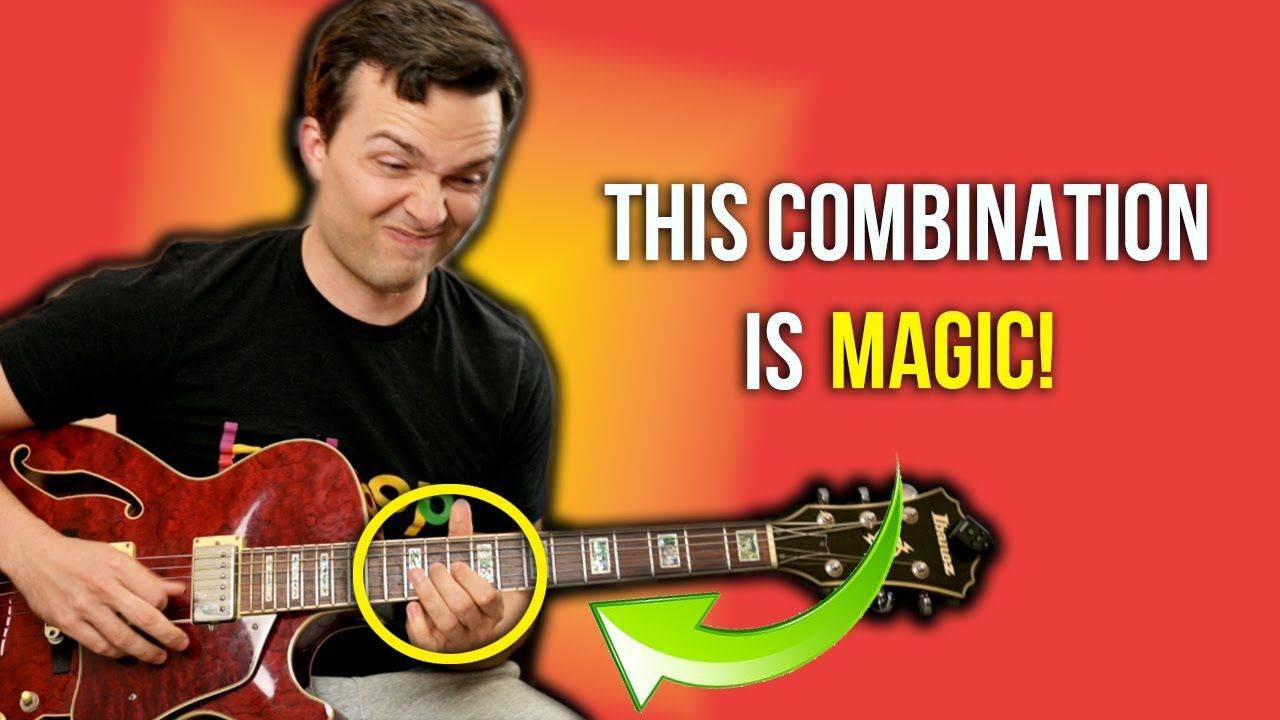
How George Benson Uses Two Minor Pentatonics in His "Breezin'" Solo
Oct 29, 2026Short answer: Over "Breezin'," which basically stays in the key of D, George Benson moves between two minor pentatonic scales. B minor pentatonic is the "pretty" sound and does most of the work. D minor pentatonic is the "bluesy" sound: it clashes with some of the chords on purpose, so he uses it in short bursts, mostly at the end of a phrase. The contrast between the two is what gives the solo its sound.
This works on "Breezin'," but also on any song where you want to add a bluesy element. ▶ 0:12
The chords to Breezin'
The progression is D, B minor, E minor, then A7 (or Asus). It's a I-vi-ii-V type of progression, and it basically stays in the key of D. That's really all you need to know for this. ▶ 0:30
The "pretty" pentatonic: B minor
The first pentatonic is what I call the pretty pentatonic: B minor pentatonic. Some people think of it as D major pentatonic. I prefer to think of all my pentatonics as minor pentatonics. Start with the basic box in 7th position. ▶ 0:46
That's the majority of what Benson plays over this tune, in various ways. It's the main way you sound like you're in D major. ▶ 1:11
The "bluesy" pentatonic: D minor
The second one is what I call the bluesy pentatonic: D minor pentatonic, over the same progression. ▶ 1:51
It doesn't fit perfectly over some of the chord changes, and that's the point. That tension is what gives it the blues sound. In bursts it sounds really good, but after a while it's too much. ▶ 2:24
| B minor pentatonic ("pretty") | D minor pentatonic ("bluesy") | |
|---|---|---|
| Notes | B, D, E, F♯, A | D, F, G, A, C |
| Role in the solo | The main course: sounds like D major | The spice: blues tension |
| Shared notes | D, A | D, A |
| Notes that signal the sound | F♯ | C, G, F |
Pair the two: main course and spice
So what's the solution? What Benson does on his actual "Breezin'" solo is pair the two. I think of B minor pentatonic as the main course, and when you want a little spice, you go into D minor pentatonic. ▶ 3:09
Save the blues sound for the end of a phrase
The bluesy D minor pentatonic sounds best at the end of a phrase, as that little extra bit to ramp up the ending. In the video I make it obvious by staying in two separate boxes: the 7th-position B minor box for pretty, and moving up to a D minor box for blues, so you can hear each switch. ▶ 3:52
As a solo develops, you can stay more on the blues side to drive up the tension and take the solo to a higher point. Using sounds that increase the tension is one way to build toward a peak. ▶ 5:06
Slide F to F♯ to get back to the pretty sound
One great note for connecting the two is F natural. F is in D minor pentatonic, F♯ is in B minor pentatonic. When you want the blues sound, use the F (F to D, for example). When you want to go back to the pretty sound, slide or bend that F into F♯. ▶ 5:27
Use the common tones
D and A are in both B minor pentatonic and D minor pentatonic, so they work in either sound. The other notes are what tell your ear which one you're in. If I want a more bluesy sound, I'll use the C natural, the G and the F, because they're not in B minor pentatonic, and your ear associates them with the blues. ▶ 6:21
Move the same double stops between both
You can use the same double stops and riffs in both pentatonics. I take a riff from my previous Benson lesson, play it in B minor pentatonic for the pretty sound, then play it in D minor pentatonic for the blues. (I couldn't help myself and slid back into the F♯ at the end.) ▶ 6:55
Hear the shift
To wrap up, I solo across the whole fretboard and switch between the pretty sound and the blues sound without telling you when. My hand position won't give it away, so listen for the shift. That will help you when you listen back to Benson's solos. This isn't only a Benson thing: guitarists like John Mayer and players in plenty of other genres do it too. ▶ 8:24
Frequently asked questions
What scale does George Benson use on "Breezin'"?
Mostly B minor pentatonic, which is the "pretty" sound in the key of D. He pairs it with D minor pentatonic for a bluesy sound, usually in short bursts at the end of a phrase.
What key is "Breezin'" in?
The progression is D, B minor, E minor, A7 (or Asus), and it basically stays in the key of D. That's why B minor pentatonic (the same notes as D major pentatonic) fits so well.
Why does D minor pentatonic sound bluesy over a D major tune?
Its F, C and G don't fit perfectly with some of the chords, and that tension is the blues sound. Used in bursts it sounds great; used too long it's too much.
How do you switch between two pentatonics smoothly?
Use the notes they share (D and A) to move between them, and use F natural sliding into F♯ to go from the bluesy sound back to the pretty one. You can also play the same double stop or riff in both scales.
Is B minor pentatonic the same as D major pentatonic?
Yes, they're the same notes. I prefer to think of all my pentatonics as minor pentatonics, so I call this one B minor.
Keep learning
- How to play like George Benson: his techniques, explained: the full map of Benson's techniques, with a lesson for each
- George Benson's pentatonic approach on "So What": more Benson pentatonic ideas, this time over a modal tune
- How George Benson makes "wrong" notes sound right: more on using tension the way the bluesy pentatonic does
Go deeper
Do you play like Benson? Take the free Guitarist Profile quiz: 10 minutes, and you get your practice mindset, your strongest and weakest skills, and a 28-day plan. Find out what kind of jazz guitarist you are →
If you want me to guide you through building your own vocabulary like this, that's what we do inside Chase's Guitar Academy, with a live class every week. You can try it free for seven days.
"I jumped in, took the trial, and saw that there were some deep dives into solo jazz guitar, as well as Wes Montgomery and George Benson and some other great things. I've not been disappointed." Mike Miller, CGA member
50+ five-star reviews from CGA members, most of them on video: read what members say.
Chase Maddox is a jazz guitarist and educator in Miami and the founder of Chase's Guitar Academy. George Benson has called him "an amazing instructor." More free lessons are on his YouTube channel.
